
Note: This is an abridged version of the whitepaper.
View the complete version
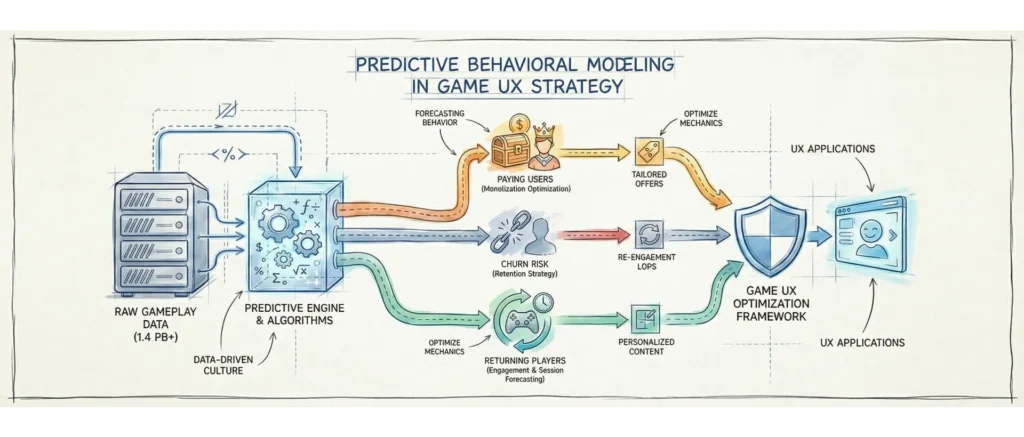
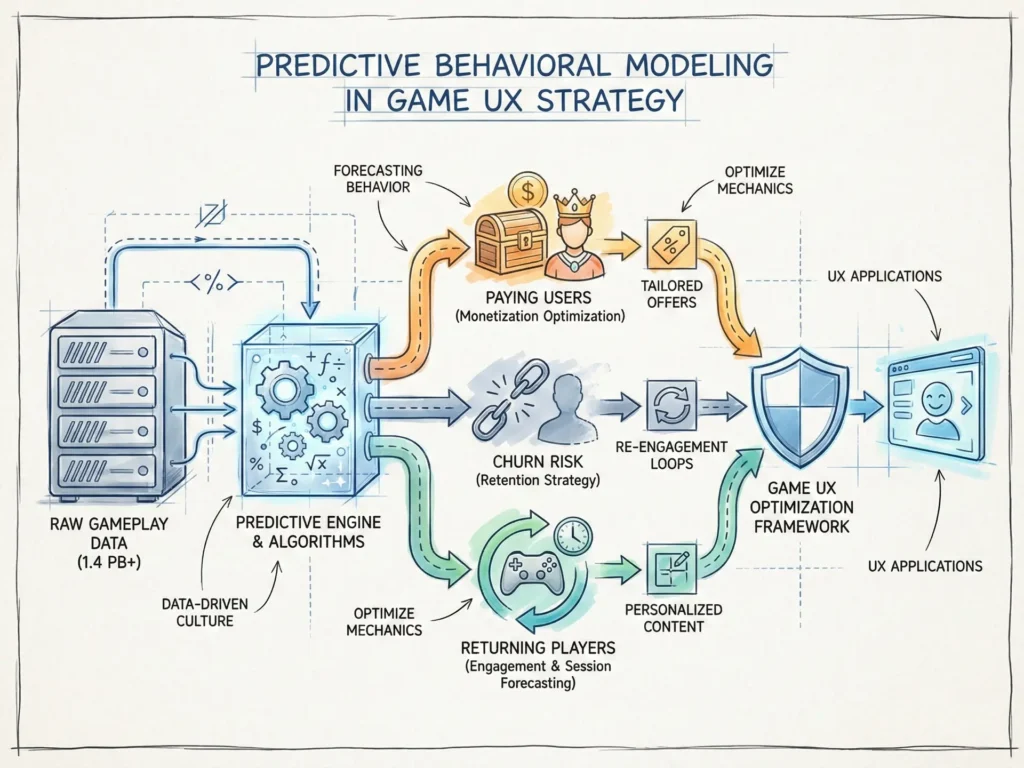
In free-to-play social games like FarmVille 2, Country Escape, Zynga Poker and match-3 titles, only a small fraction of players pay for virtual goods. As Zynga noted, it is therefore essential to retain existing users and get them to return frequently (for ad revenue) while optimizing game mechanics to squeeze money out of paying users. To this end, Zynga built a data-driven culture, collecting petabytes of gameplay logs (1.4 PB of data by 2012 ) to optimize retention, engagement and monetization.
Today’s computing power makes it feasible to leverage this data for predictive modeling: forecasting which players will eventually pay, which will churn, and when lapsed players will return (and how long they will play per session).
This whitepaper outlines a conceptual framework for such predictive player-behavior models in Zynga’s games, detailing objectives, data features, modeling methods, and UX applications.

Data-Driven Design and Analytics Culture
Zynga exemplifies a metrics-centric approach to game design. The company tracked every user action via internal tools (e.g. ZTrack), enabling real-time dashboards and rapid A/B tests. Designers focused on the 3 R’s – Reach, Retention, Revenue – with retention viewed as a crystal ball for long-term success. By analyzing vast telemetry (sessions, purchases, social interactions, etc.), Zynga continuously tuned game loops.
For example, cohort analysis – grouping players by install date or behavior – helped spot early lifecycle patterns. Analytics platforms describe cohorts as a way to understand how new users behave over time and highlight differences in engagement or spending between segments.
Developers routinely identify high-performing cohorts (e.g. those with strong Day-1 retention or early purchases) to guide live-ops and feature prioritization.
Predictive Modeling Objectives
Building on these insights, predictive behavior models aim to anticipate key player actions before they happen. In Zynga’s context, we focus on:
Conversion to Pay
Estimating when a free player will make a real-money purchase (or become a paying user). Models analyze early engagement patterns and in-game actions to predict future spending. For instance, metrics like session frequency or exploratory behavior can flag users likely to convert (mirroring techniques used in iGaming for lifetime-value forecasting).
Churn Risk
Identifying players at risk of quitting (e.g. not returning in the next week). By modeling declines in activity (fewer sessions, stalling progression, reduced social engagement), classification models can flag likely churners. Such churn predictions let designers intervene early (see Applications below).
Re-Engagement Timing
Predicting when lapsed or infrequent players will next return, including the likely day of week, time of day, and session length. This is a ‘time-to-event’ problem often tackled with survival analysis or hazard models. For example, Srivastava et al. (KDD 2014) framed return-time prediction using Cox proportional-hazards models, achieving far better accuracy than baseline regressions. Time-series methods can similarly forecast session durations or intersession gaps.
Data Collection and Feature Engineering
Predictive models require rich user data from multiple sources. Key feature categories include:
Gameplay Activity
Level progression (current level, levels completed), session counts and lengths, time-of-day of play, in-game actions. (E.g. a churn-study logged Candy Crush players] levels, number of attempts, time on each feature, booster uses and social invites.)
Engagement Signals
Usage of power-ups/boosters, completion of daily quests or challenges, streak counts, social interactions (sending/receiving invites, guild chat participation). These reflect how deeply players engage with game features.
Monetization Data
Purchase history (in-app item, amount, timing), ad interactions. For example, tracking a player’s spending events – including amount, time, and item type – provides direct signals of paying behavior.
Derived Metrics
Aggregated measures like total playtime, average session duration, recency (days since last session), session frequency, and trend slopes (e.g. accelerating or declining play). Such features capture momentum in player engagement.
Cohort Attributes
Labels or clusters based on installation date, acquisition source, or early behavior. By grouping players into cohorts, we account for external factors (like game version or seasonal effects) when modeling. These cohort labels can be used as inputs or to create reference groups.
These features are obtained from telemetry pipelines that record millions of datapoints per second. Before modeling, raw logs are preprocessed: missing or inconsistent entries are cleaned/imputed, and numeric features normalized to prevent scale imbalances. Then feature engineering transforms raw signals into model-ready attributes.
For example, one analysis generated variables such as average daily login duration to complete a level, rate of level advancement, total booster usage, and fraction of playtime spent in social areas. These engineered features enrich the data and improve prediction of outcomes like churn.
Modeling Approach
Predictive modeling proceeds in stages:
Data Preprocessing:
Clean and normalize all collected user data. Handle missing values and remove anomalies to ensure model quality. Optionally use dimensionality reduction (e.g. PCA) to manage high-dimensional features.
Feature Engineering:
As above, compute aggregated metrics (avg. sessions/day, days-since-last-play, cumulative spend) and any behavioral ratios (e.g. win rate, purchase rate). Use domain insight to capture trends (e.g. engagement decay). Time-series forecasting methods may be applied to features like session gap or duration.
Model Training:
Fit machine learning models to predict targets. For churn/conversion, treat it as a binary classification/regression problem. Algorithms like Logistic Regression, Random Forests or Gradient Boosting are common choices. (Lilin Peng et al. 2025, for instance, built Random Forest and Logistic Regression churn models on game data.) Ensembles or neural nets can capture complex nonlinearities. For return-time prediction, train survival/hazard models (e.g. Cox regression) or regression on time-to-next-event.
Validation:
Evaluate model performance using appropriate metrics. Classification tasks use AUC-ROC, precision/recall and F1-score; regression or survival tasks use error measures like SMAPE or concordance index. (For example, F1-score is the harmonic mean of precision and recall, and a higher AUC indicates better churn-classification performance.) Choose the model that best balances accuracy and robustness on held-out data.
Iteration:
Refine features and retune models as needed. If a model underperforms, consider additional behavioral covariates (e.g. social network features) or try more advanced techniques (deep learning, time-series RNNs, etc.).

Applications to UX and Monetization
By embedding these predictive models into the game ecosystem, UX and marketing teams can act proactively:
Targeted Interventions
If a model flags a player as likely to churn soon, the game can trigger retention strategies (e.g. time-limited rewards, tutorial hints, or push notifications) customized to that user. In one study, personalized push notifications sent to users predicted to churn led to a 28% reduction in actual churn.
Personalized Progression
Predictions of return-time or engagement level can adjust the game experience. For example, knowing a player is likely to return in two days could alter daily quest resets, or prompt difficulty-scaling. Modern AI-driven systems can use these signals to make ‘dynamic adjustments to difficulty curves’ and tailor content recommendations before players even ask for them.
Optimized Monetization
Anticipating which players will pay allows better in-game store placement and offer timing. Models identifying high-value segments (VIPs) or pending converters inform marketing budgets and promotional strategies. Industry guides note that predictive analytics for player value directly shapes retention strategies and bonus targeting.
Product Planning
Aggregate forecasts (e.g. total expected DAU, weekly churn rate, revenue curves) help plan content updates and live-ops schedules. Early warnings from models can flag when key KPIs might deviate, enabling data-driven UX decisions.
Each application feeds back into UX strategy: by predicting user actions, designers can craft individualized experiences that maximize engagement and lifetime value. In other words, predictive models become tools in the UX toolkit, enabling a shift from reactive game tuning to proactive user journey design.
Technical Considerations
Such modeling requires significant data and computational resources. Zynga’s scale – over a petabyte of logs and millions of DAU – means big-data infrastructure (distributed storage, GPU/cluster compute) is needed. Models should also respect privacy and opt-out rules for tracking. Practically, an initial proof-of-concept might sample a subset of users or focus on one game (e.g. FarmVille2) to validate the approach.
Successful pilot results would justify scaling to the full game ecosystem. Note that past efforts faced hurdles: even Zynga’s early attempts at ML-driven personalization (e.g. Looney Tunes Dash experiments) ran into learning-curve challenges. However, modern ML platforms and cloud resources now make such analyses tractable.
Conclusion
Predictive behavioral models hold strong promise for game UX strategy. By forecasting player conversions, churn, and return patterns, developers can engage users at the right time with the right content. Zynga’s own data-rich history – and the broader gaming industry’s turn toward AI-driven analytics – suggests this concept is ripe for testing. As one industry report notes, – predicting player lifetime value has become a crucial strategic advantage – and AI-driven insights can be turned into higher retention and profitability.
Our proposed framework outlines how a gaming company can combine telemetry, cohort analysis, and modern ML to unlock these advantages. A proof-of-concept implementation would empirically demonstrate the value of predictive UX design, potentially setting a new standard for data-informed game development.
Sources: Industry and academic literature on game analytics and predictive models.