
The Hyperlocal Civic Engagement Platform & Trust Layer
This POC project, currently Work in Progress.
Project
CivicLens
ROLE
UX Strategy,
Product Design
(Community Open Source POC)
Stage
Design in Progress,
Engineering Pending
Context: Community Open Source Project (Bangalore)
1. Executive Summary
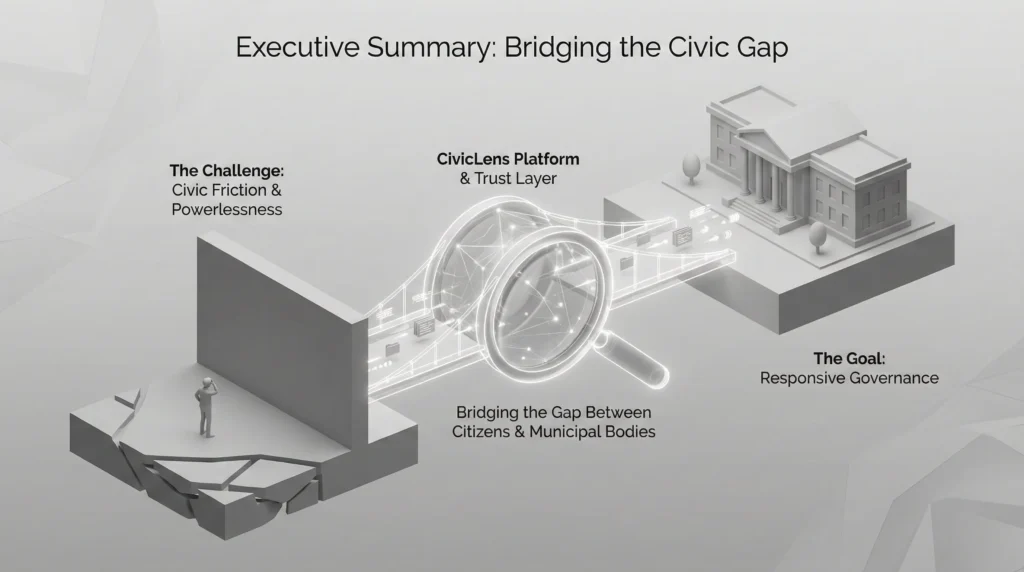
The Challenge: Civic engagement in rapidly urbanizing cities like Bangalore is defined by a ‘mundane tragedy’. 90% of complaints come from 10% of the population, while the remaining majority feels powerless against opaque bureaucracies. The friction of engagement, clunky websites, obscure forms, and lack of feedback, is often mistaken for citizen apathy.
The Solution: CivicLens is an open-source, hyperlocal engagement platform designed to bridge the gap between citizens and municipal bodies. It moves beyond simple ‘complaint logging’ to create a ‘Civic Texture Map’, a living, breathing knowledge graph of neighbourhood health, sentiment, and infrastructure.
The Leadership Pivot: Initially conceived as a transactional ‘pothole reporter’, I steered the product strategy toward a ‘Trust Data Layer’. By recognizing that the value wasn’t just in fixing the problem but in documenting the system, we shifted the focus to creating read/write APIs for municipal systems and fostering a social validation layer for community issues.
2. Discovery & Research
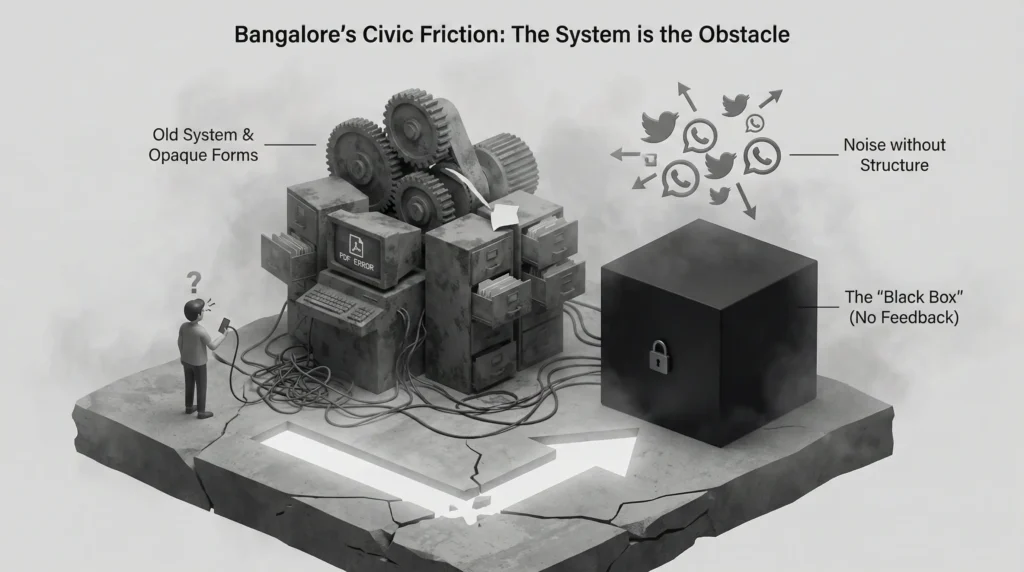
2.1 The Context: Bangalore’s Civic Friction
Bangalore (Bengaluru) is a metropolis of rapid growth and infrastructure stress. Our initial environmental scan revealed that citizens often rely on disjointed WhatsApp groups or Twitter (X) outbursts to flag issues, resulting in noise without structure.
2.2 User Research & Insights
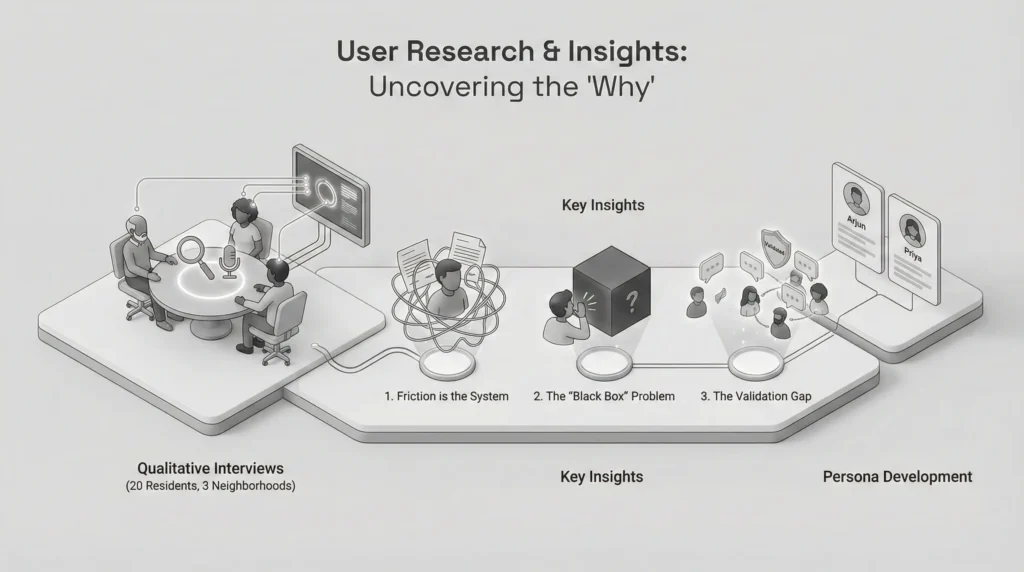
We conducted qualitative interviews with 20 residents and 5 civic activists across three distinct neighborhoods (Greater MG Road, Indiranagar, Whitefield, Malleshwaram).
- The ‘Friction is the System’ Insight: Users aren’t apathetic; they are exhausted. Reporting a zoning violation or a dangerous intersection requires navigating archaic portals or physical visits.
- The ‘Black Box’ Problem: Users who did report issues rarely received updates. “It felt like shouting into a void,” one participant noted.
- The Validation Gap: Citizens often felt their individual voice wasn’t enough. They needed a way to show that ’50 other people on this street agree this is a problem’.
2.3 Personas
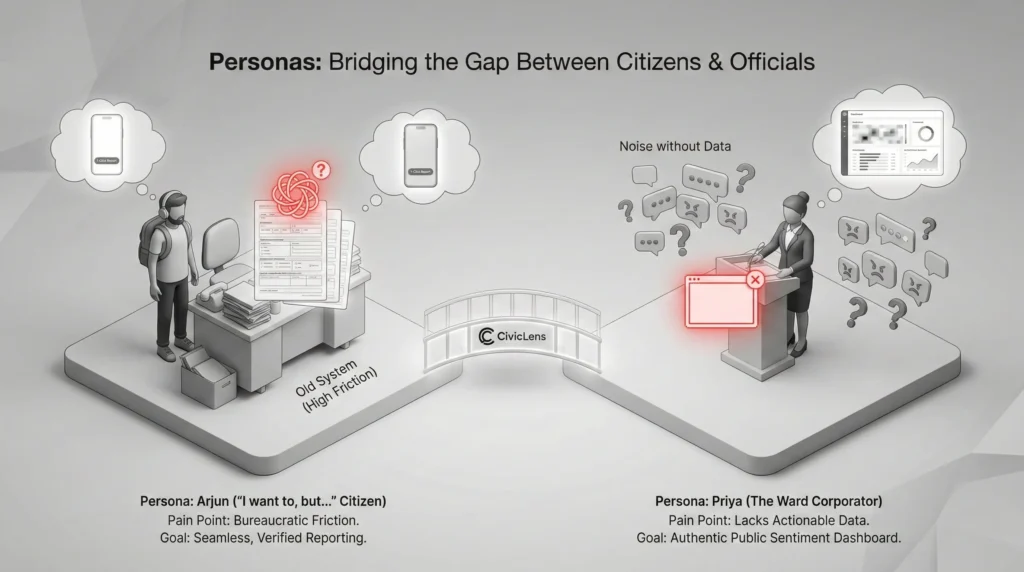
| Persona | Arjun, The “I want to, but…” Citizen | Priya, The Ward Corporator (Official) |
| Profile | Tech-savvy professional, 32. Busy, cares about his neighborhood but has zero tolerance for bureaucracy. | Elected representative. Needs authentic public sentiment to prioritize limited budgets. |
| Pain Point | “I’d attend a meeting if it was 2 clicks. I want to report a pothole without filling out a 10-field PDF.” | “I get screamed at on the phone, but I lack data. I need to know what the silent majority actually cares about.” |
| Goal | Seamless, verified reporting with status tracking. | A dashboard of heat-mapped issues to allocate resources efficiently. |
2.4 Competitive Analysis: The Landscape of Civic Tech in Bangalore
Currently, the civic engagement space in Bangalore is fragmented into two main categories: official government portals that suffer from a trust deficit, and third-party platforms that lack direct integration with municipal workflows. CivicLens is positioned to bridge this gap.
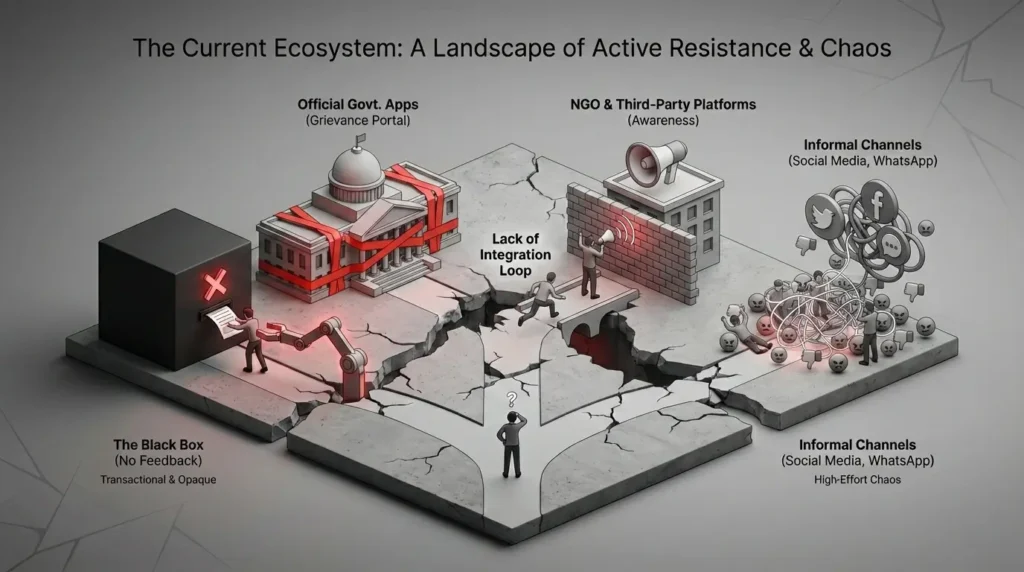
a. The Current Ecosystem
| Category | Key Players | Primary Function | User Experience & Limitations (The “Friction”) |
| Official Govt. Apps | BBMP Sahaaya 2.0 (Namma Bengaluru), Swachhata-MoHUA | Grievance Redressal: Formal channels for logging complaints about roads, garbage, streetlights, etc. | The “Black Box” Problem: Users report issues into a void. Complaints are often marked “resolved” without a fix or explanation, eroding trust. The interfaces are often clunky, form-heavy, and feel like digital bureaucracy. |
| NGO & Third-Party Platforms | I Change My City (Janaagraha), Public Eye | Awareness & Reporting: Platforms focused on citizen connection, data transparency (e.g., budgets), and specific issue reporting (e.g., traffic violations). | Lack of Integration Loop: While strong on community building and awareness, these platforms often lack direct, two-way read/write integration with official municipal work-order systems. They act more as pressure groups than integrated tools. |
| Informal Channels | Reddit (r/bangalore), X (Twitter), WhatsApp Groups | Venting & Ad-hoc Organizing: The default for most engaged citizens to share frustration, photos, and rally neighbors. | Noise Without Structure: Highly unstructured data that is impossible for officials to parse or act upon systematically. High effort for citizens with low guarantee of outcome. |
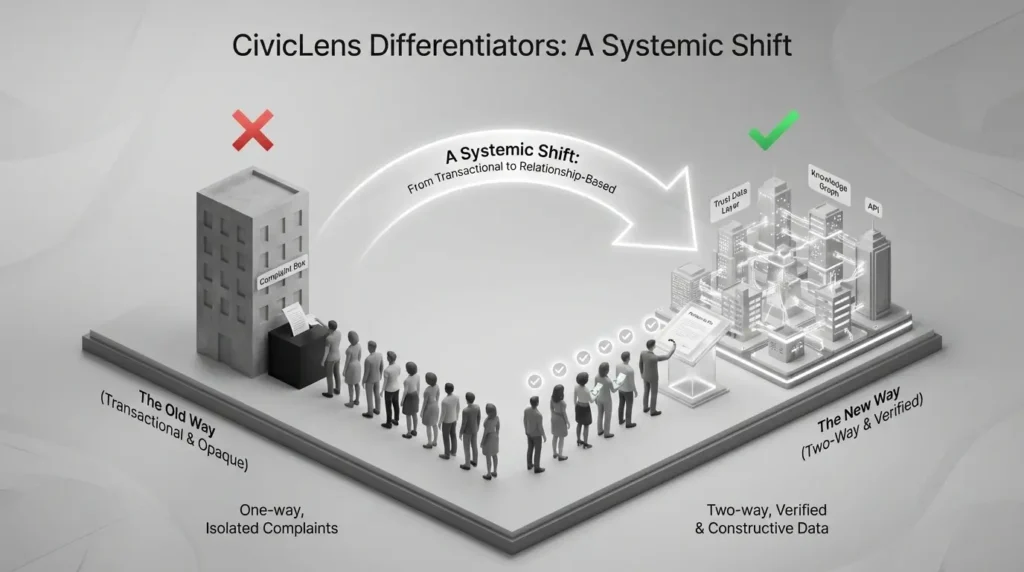
b. CivicLens Differentiators: A Systemic Shift
CivicLens is not just another “complaint app.” Its strategy addresses the fundamental flaws in the existing ecosystem by shifting from a transactional model to a relationship-based data model.
| Feature/Strategy | Existing Solutions (The Status Quo) | CivicLens Advantage (The Pivot) |
| Core Philosophy | “Log a complaint.” (Transactional) | “Build a Knowledge Graph.” (Constructive) Users aren’t just reporting; they are mapping their community’s infrastructure health. |
| Data Flow | One-way: Citizen -> Government (Black Box) | Two-way Trust Layer: Read/Write API integration with municipal systems meant citizens get real status updates (e.g., “Work Order #123 Created”), closing the feedback loop. |
| Social Dynamic | Individual & Isolated. A user is one voice. | Collective & Validated. A “Petition to Fix” model where neighbors can upvote/sign an issue, providing officials with verified social proof of a problem’s urgency. |
| Rollout Strategy | “Boil the Ocean” (Try to digitize everything at once). | “Hyperlocal Hook” (Horizon 1): Start with one visceral problem (e.g., potholes) in one pilot neighborhood to prove utility and build a sticky user base before expanding. |
| Identity | Often anonymous or loosely verified, leading to spam/trust issues for officials. | “Verified Resident” Tier: Optional verification for signing petitions, giving officials confidence that the data represents real constituents, not bots. |
Conclusion on Competition: Existing tools have digitized the forms of bureaucracy without fixing the processes. CivicLens aims to digitize the trust and social fabric of a community, creating a layer of validated data that municipal bodies can’t ignore and citizens actually want to use.
3. System Thinking & Strategy
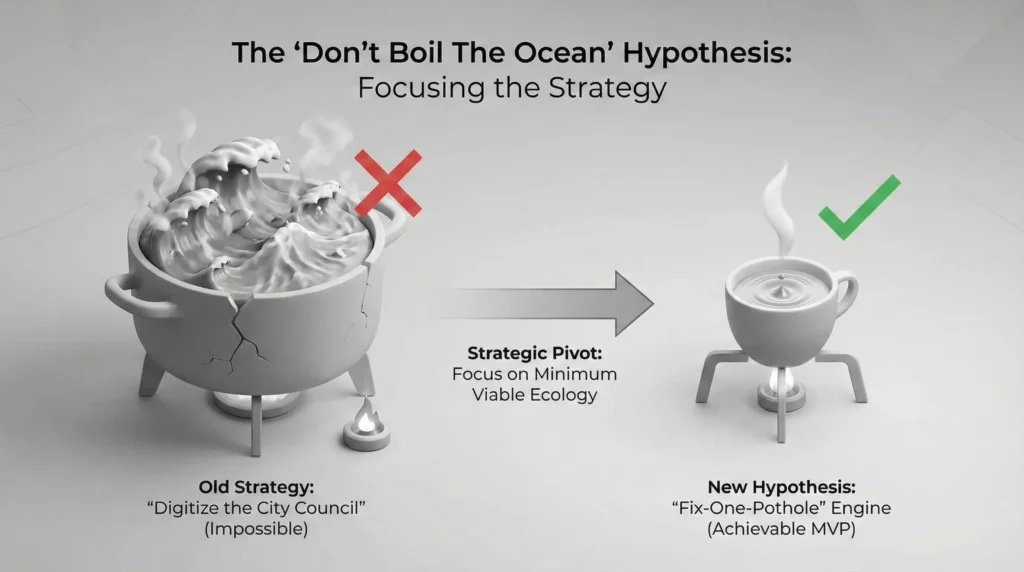
The ‘Don’t Boil The Ocean’ Hypothesis
As the Design Leader, I established a constraint to prevent feature creep. We rejected the idea of ‘digitizing the entire city council’. Instead, we focused on a Minimum Viable Ecology:
Hypothesis: If we start with just one, visceral, hyperlocal issue (e.g., a notorious pothole), can we get 100 people to use a new kind of petition?
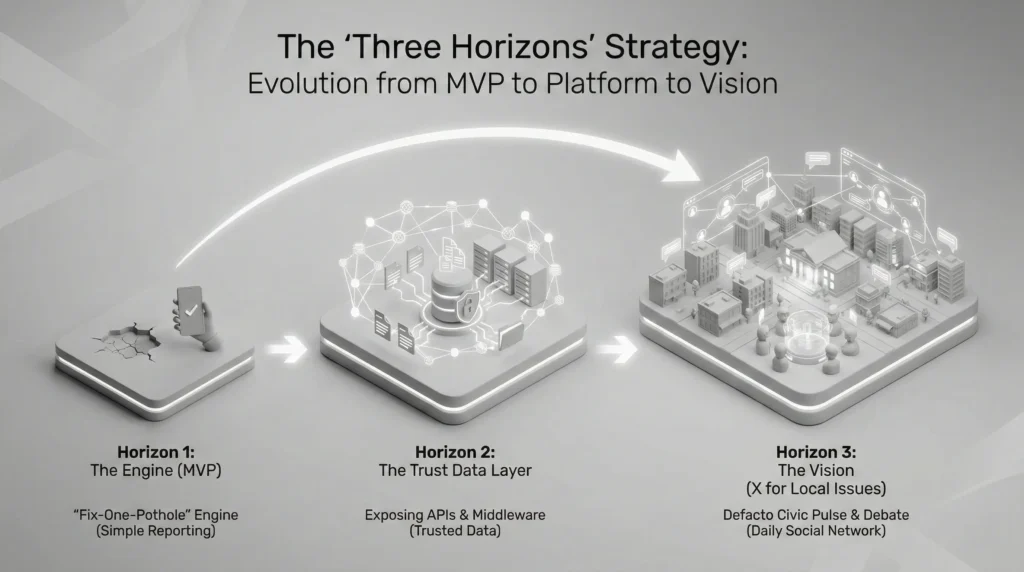
The Three Horizons Framework
To guide the roadmap and engineering efforts, I structured the product vision into three strategic horizons:
- Horizon 1 (The Hook – MVP): The ‘Fix-One-Thing’ Engine.
- Focus: Solve one specific problem beautifully.
- Mechanism: A frictionless reporting tool with photo capture, geo-tagging, and auto-notification to relevant officials.
- Goal: Prove utility and gain initial trust.
- Horizon 2 (The Platform): The Trust Data Layer.
- Focus: Exposing the data.
- Mechanism: Shifting from a ‘reporting tool’ to a middleware that offers Read/Write APIs for the town’s existing systems (Work Order mgmt, 311).
- Goal: Become the trusted, real-time sentiment layer on top of municipal governance.
- Horizon 3 (The Vision): The ‘X’ for Local Issues.
- Focus: Governance & Debate.
- Mechanism: The platform becomes the venue for debating development bids, school bonds, and zoning changes, annotated by the residents who live there.
- Goal: A daily-use social network anchored in physical reality.
4. The Strategic Pivot
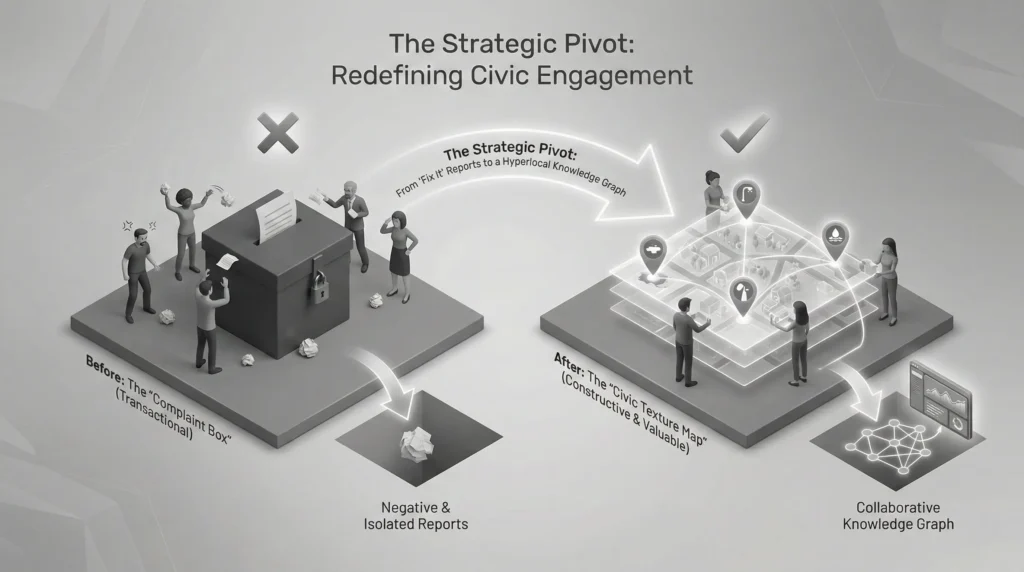
From ‘Complaint Box’ to ‘Civic Texture Map’
Midway through the design phase, early prototype testing revealed a crucial behavior: Users weren’t just complaining; they were creating maps. They were flagging flooding zones, dangerous intersections, and dark spots on streets.
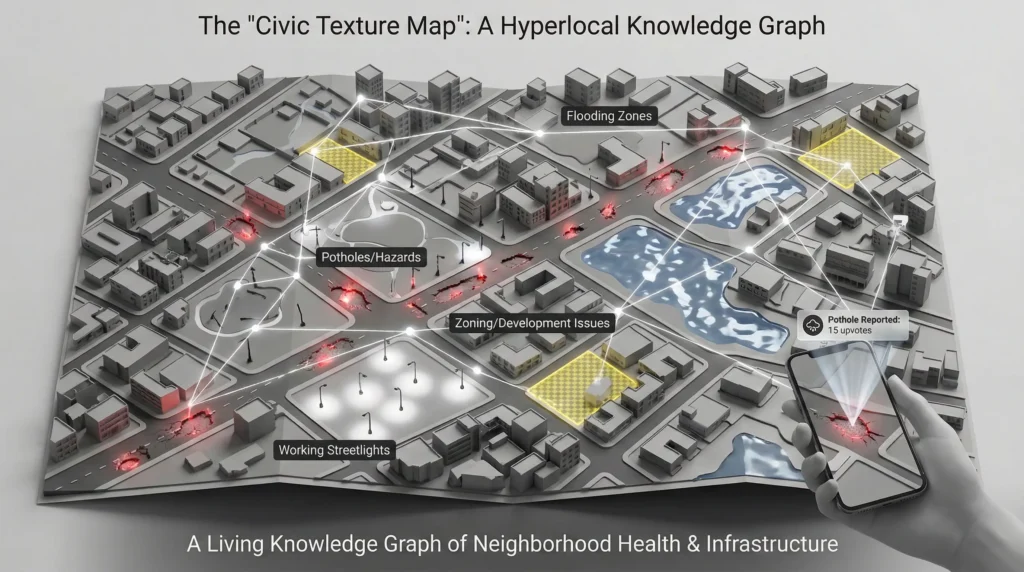
The Leadership Decision:
I recognized that a ‘Complaint Box’ is negative and transactional. A ‘Civic Texture Map’ is constructive and valuable.
- The Pivot: We shifted the core UI from a ‘Report Issue’ form to a Map-First Interface.
- The Value Prop: Instead of just sending a report to the void, the user contributes to a ‘Knowledge Graph’ of their neighborhood.
- Outcome: ‘This spot floods’ becomes a data point validated by 7 neighbors. This aggregate data is invaluable to city planners and the Mayor’s office, transforming the app into a decision-support system.
5. UX Design & Workflows
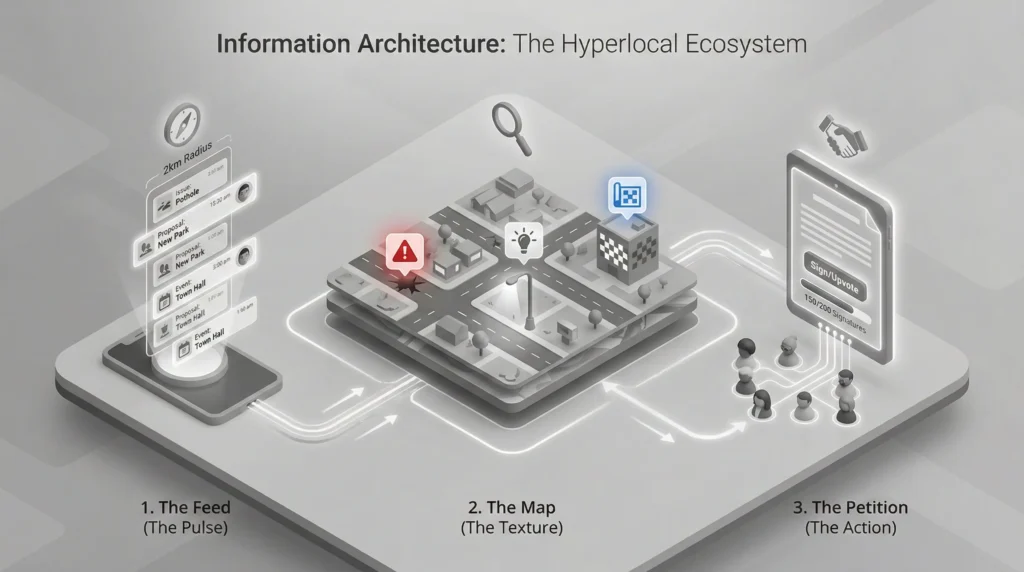
Information Architecture
The app is structured around the ‘Hyperlocal Radius’, a user’s profile is effectively their street and community.
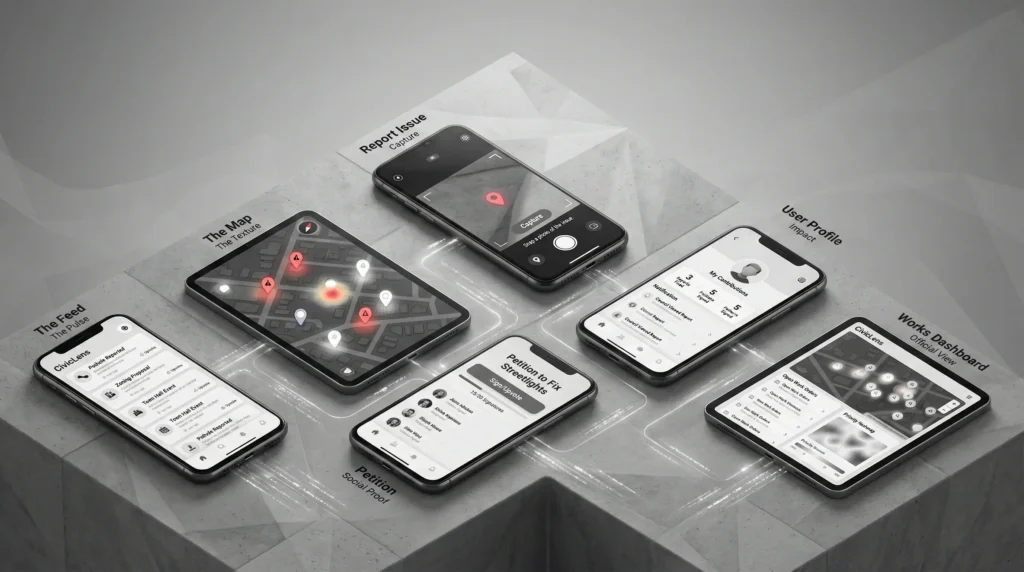
- The Feed (The Pulse): A geolocated feed of active issues, proposals, and events within a 2km radius.
- The Map (The Texture): Visualizing infrastructure health (potholes, lights, zoning).
- The Petition (The Action): A structured tool to gather support.
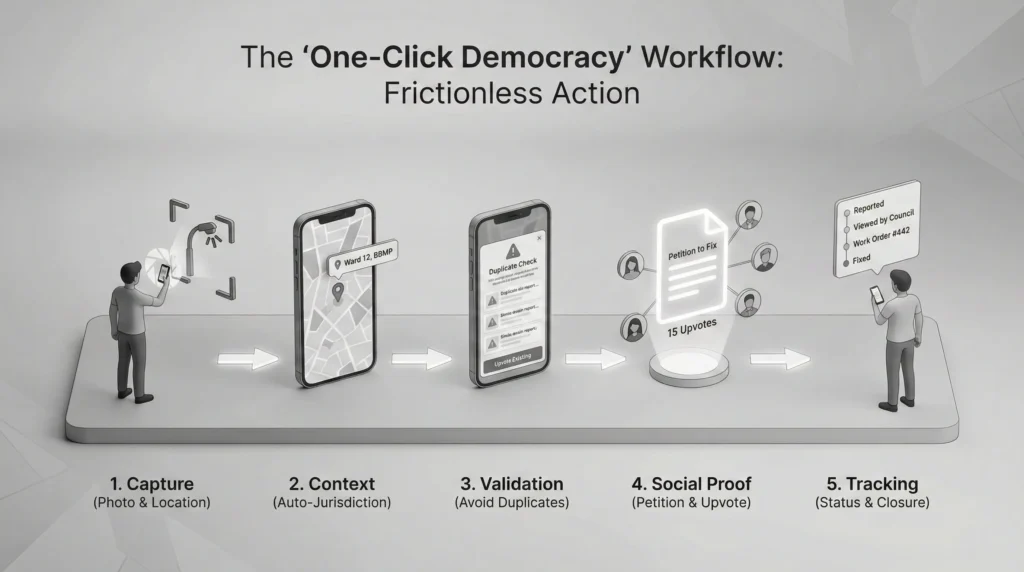
Core Workflow: The ‘One-Click Democracy’
We designed the reporting flow to be as addictive and simple as a social media post, but with the rigor of a legal document.
- Capture: User snaps a photo of a broken streetlight.
- Context: The system auto-detects location and suggests the correct jurisdiction (e.g., BBMP Ward 12).
- Validation: The user adds a brief description. The system checks for duplicates: “3 neighbors have already reported this. Do you want to upvote/sign their petition instead?”
- Social Proof: The report becomes a ‘Petition to Fix’, visible to neighbors who can ‘Sign’ (upvote) it.
- Tracking: The user receives push notifications: ‘Councilor Sharma has viewed your report’ -> ‘Work Order #442 Created’ -> ‘Fixed’.
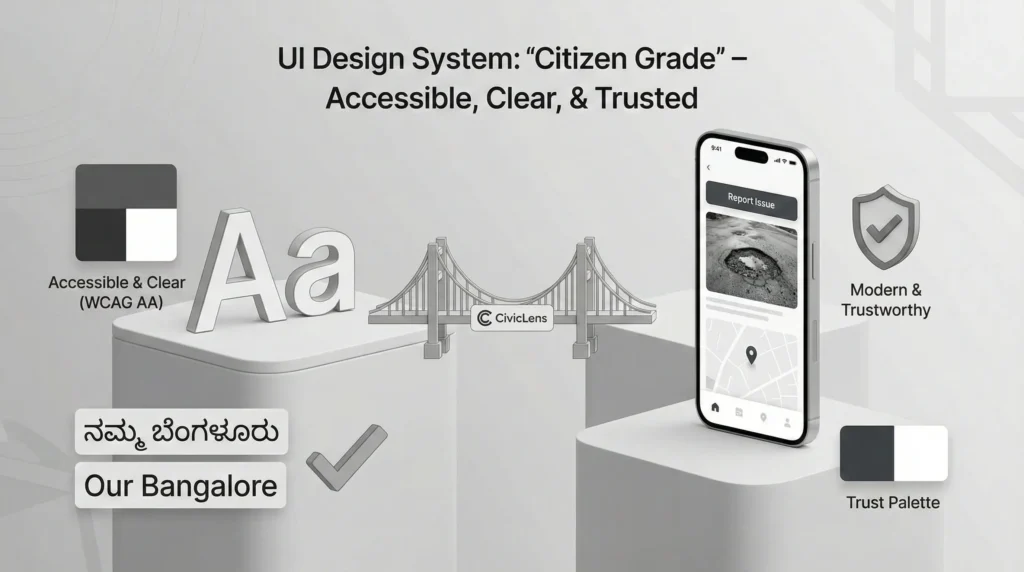
Design System: ‘Citizen Grade’
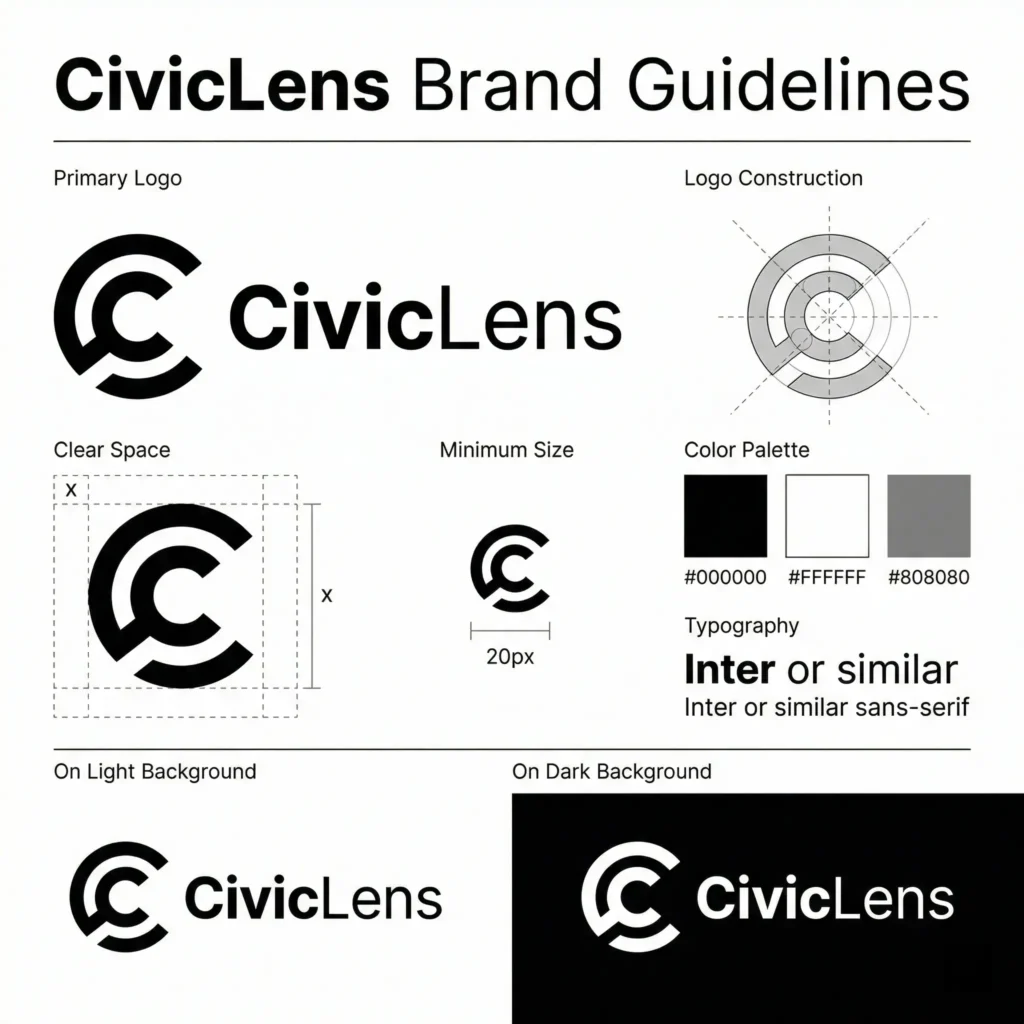
- Visual Style: Clean, high-contrast, accessible (WCAG AA). We avoided ‘government beige’ in favor of a vibrant, trustworthy palette (Deep Blues, Signal Oranges) that feels like a modern tech product.
- Typography: Highly legible sans-serifs optimized for localized languages (Kannada, English, Hindi).
Mobile App [WIP]

Civiclens Splash Screen

Civiclens Home Feed

Petition Details

Issue Details

Issue Details Comment

Report Issue Capture

Search And Explore Bangalore

User Profile

6. Complex Problem Solving
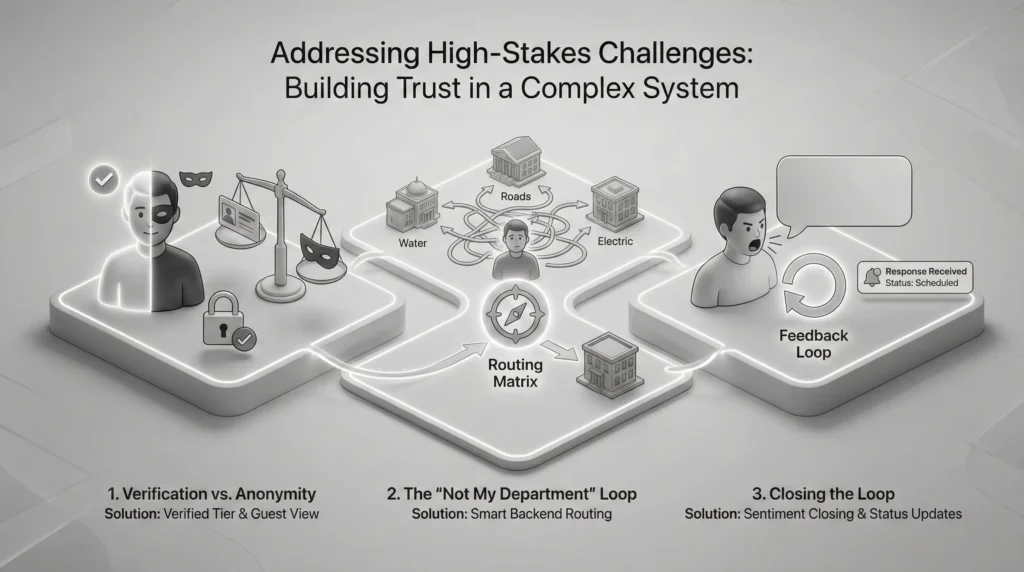
Addressing High-Stakes Challenges
Designing for civic engagement introduces risks that standard B2C apps do not face.
- Verification vs. Anonymity:
- Problem: How to prevent spam/trolling while protecting user privacy?
- Solution: We implemented a ‘Verified Resident’ tier (using utility bill OCR or OTP) for voting/petitioning, while allowing ‘Guest’ viewing. This ensures officials trust the data.
- The ‘Not My Department’ Loop:
- Problem: Citizens don’t know which agency handles what (Water board vs. Electric vs. Road).
- Solution: A backend routing matrix. The user just says ‘Water Leak’, and the system routes it to the correct department (BWSSB) based on the geo-coordinates.
- Closing the Loop:
- Problem: The biggest killer of civic trust is silence.
- Solution: We designed ‘sentiment closing’. Even if the city can’t fix the pothole immediately, an official response (‘Scheduled for Q3 Repaving’) closes the ticket and satisfies the user’s need to be heard.
7. Conclusion & Impact Potential
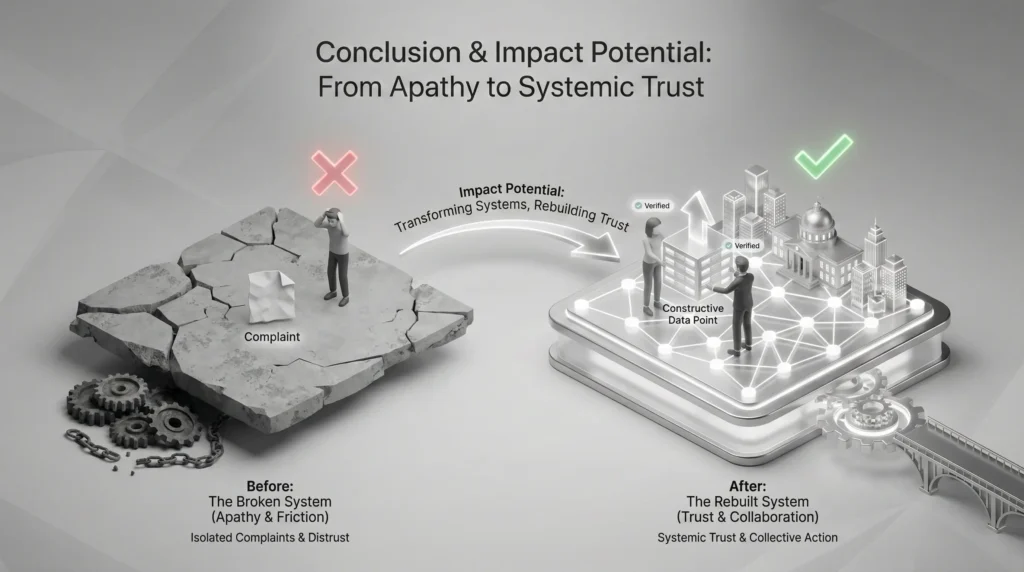
CivicLens demonstrates that the solution to civic apathy isn’t better marketing, but better systems design. By treating civic engagement as a UX problem, reducing friction, increasing transparency, and visualizing social proof, we can transform a ‘complaint’ into a ‘constructive data point’.
Next Steps:
This project is currently ready for engineering hand-off as an open-source initiative. The Work-in-Progress design documentation includes a full design system, API schemas for municipal integration, and a roadmap for community rollout in a pilot ward in Bangalore.
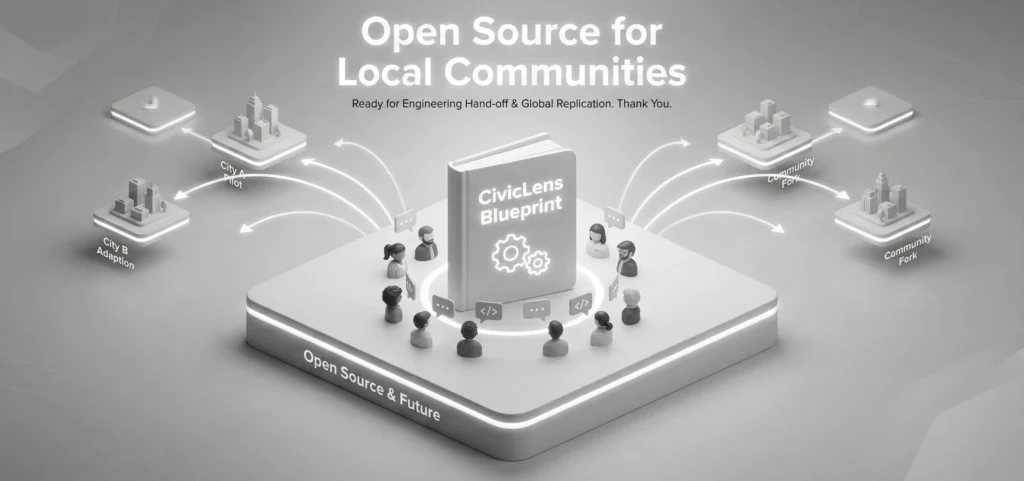
Key Takeaway:
As a UX Leader, this project highlights my ability to move beyond interface design into Service Design and Political/Social Systems Engineering, proving that digital products can rebuild trust in physical communities.
Visual Assets