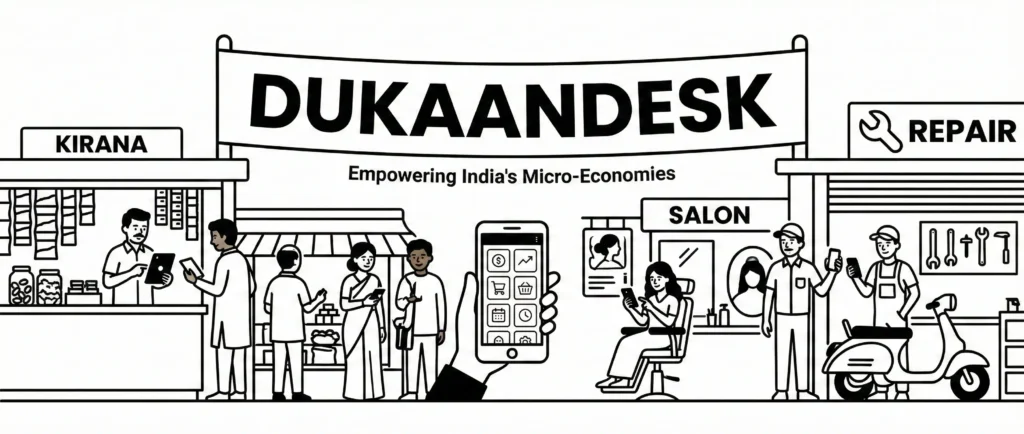

Empowering India’s Micro-Economies Through Accessible Tech
Work in progress
Project
DukaanDesk
ROLE
Lead Product Designer / Project Lead
(Community Open Source POC)
Year, Timeline, Stage
2026, 6 Weeks
(Discovery to Final High-Fidelity Prototypes)
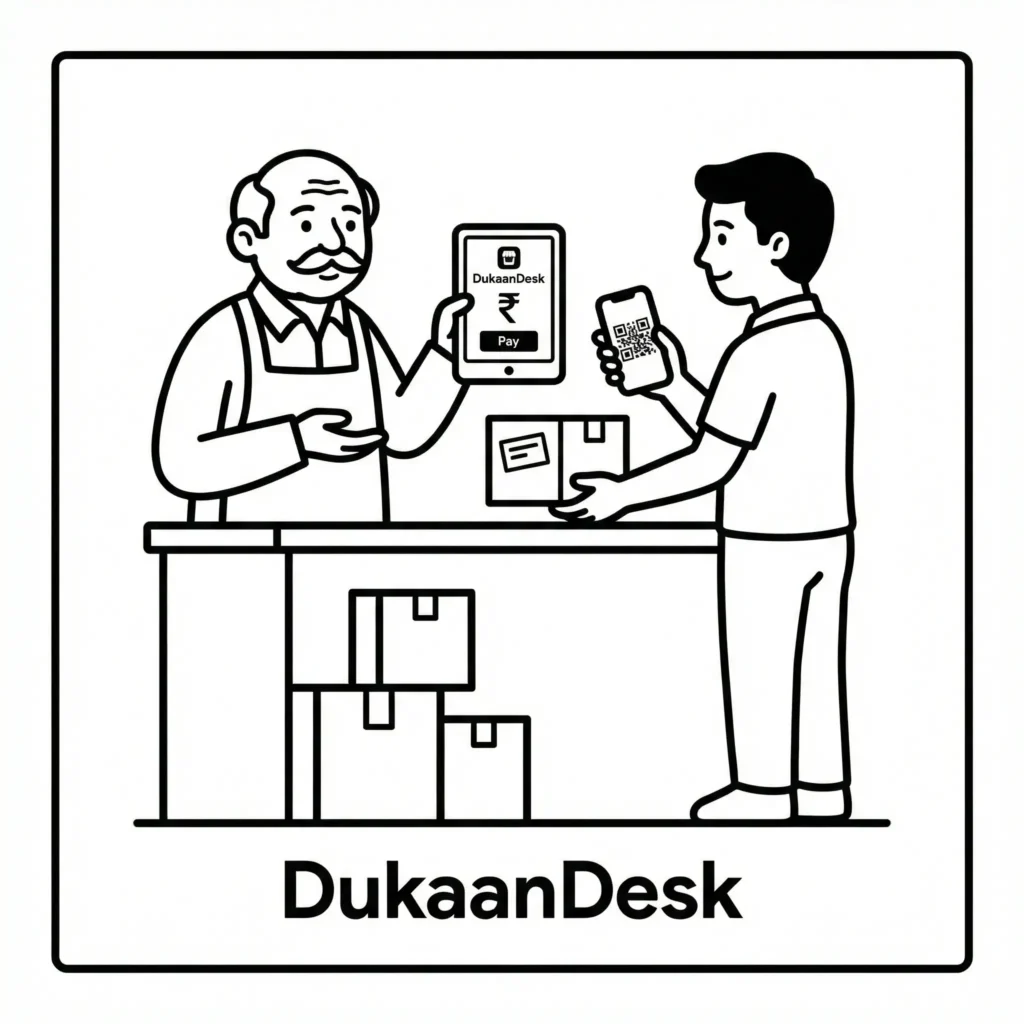
Platform: Mobile-First (Android Native focus), Offline-Capable
Domain: B2B Micro-SaaS / Retail & Service Operations
MVP: Github
Executive Summary
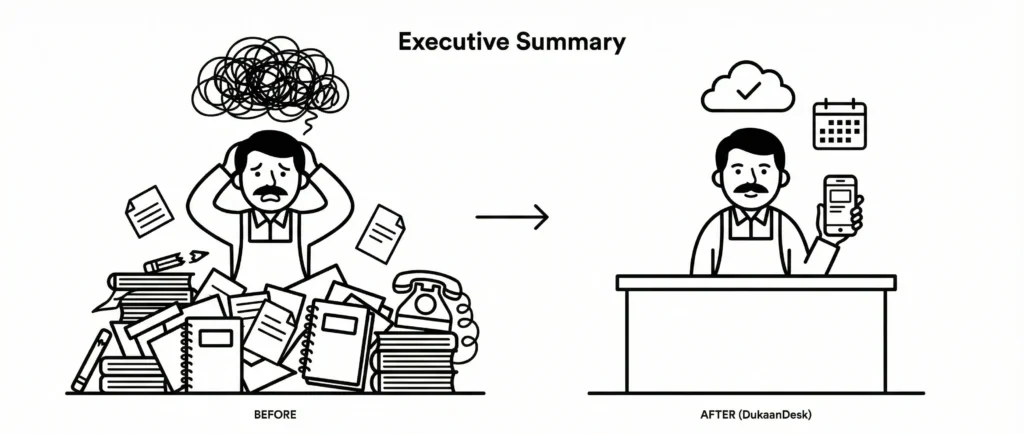
India’s neighborhood economy, comprising millions of Kirana stores, local salons, and repair shops, is under siege. As Quick Commerce and big retail optimize their supply chains, local micro-SMBs are left managing operations through fragmented, analog systems: WhatsApp, physical notebooks, and memory.
DukaanDesk (formerly ServiceSync) is an open-source Mobile Ops Hub designed to act as a digital cash register and dispatcher. The core objective was to replace 2-3 hours of daily administrative burnout with a sticky, transactional core loop that saves time, prevents stockouts, and minimizes missed appointments, without the steep learning curve or cost of enterprise tools like Zoho.
1. The Challenge & UX Strategy
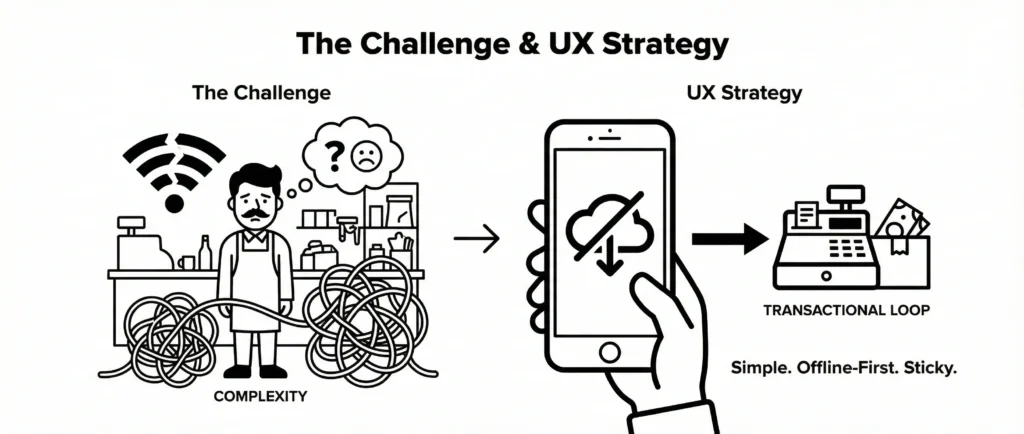
Micro-business owners in high-traffic, hyper-local markets like Bengaluru face unique environmental and operational constraints. They operate in high-stress, low-margin environments where connectivity is often spotty, and digital literacy varies wildly between the owner and their staff.
The Strategy: Design a utilitarian, daily-sticky application. The system needed to be entirely transactional, every sale or customer interaction updates inventory and schedules automatically. My approach prioritized an Offline-First architecture, minimal cognitive load, and inclusive design (vernacular support and error-proofing) to ensure immediate adoption and high retention.
2. Discovery & Market Study
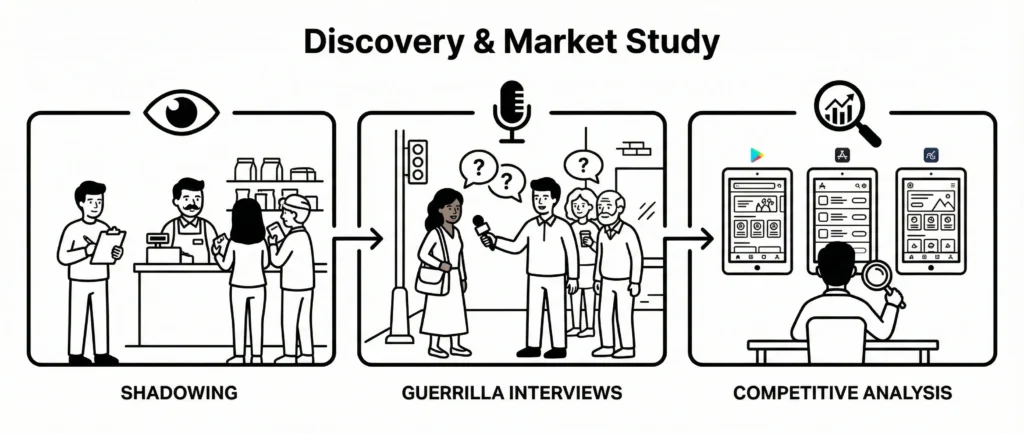
To understand the ground truth, I bypassed sterile lab research and went directly into the field.
- Contextual Inquiry (Shadowing): Spent time behind the counter at 6 local Bengaluru businesses (3 Kiranas, 2 salons, 1 appliance repair hub) observing the ‘counter chaos’ during peak hours.
- Guerrilla Interviews: Surveyed owners on the frequency of specific pain points: stockouts, expired goods, no-show appointments, and end-of-day reconciliation fatigue.
- Competitive Analysis: Evaluated tools like Zoho, KhataBook, and generic POS systems. The Gap: Existing tools either focused purely on ledger management (ignoring inventory/appointments) or were too complex and required constant internet access, leading to high abandonment rates.
3. Empathy & System Thinking
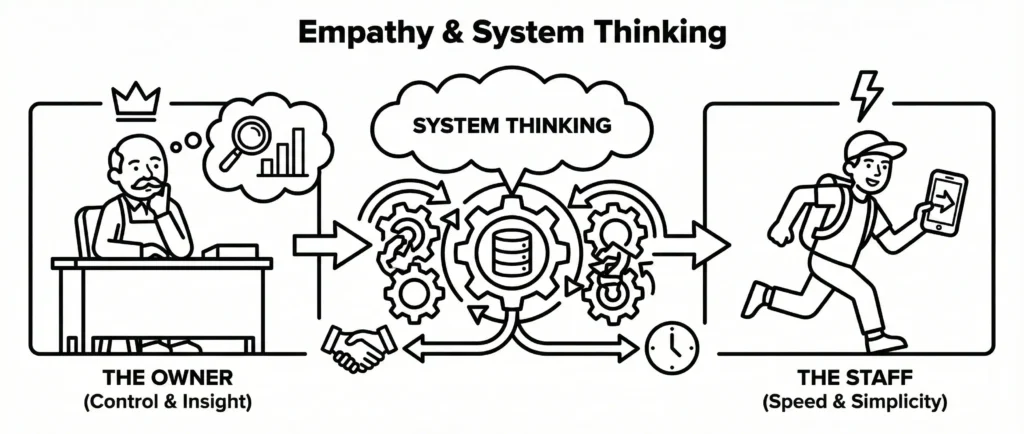
Synthesizing the research revealed a dual-user ecosystem with competing needs. The system had to serve both the overarching control needed by the owner and the rapid, frictionless input required by the staff.
User Personas
- The Owner (e.g., Anand, 45, Kirana Owner): Needs an eagle-eye view of daily sales, low-stock alerts, and end-of-day reconciliation. Not highly tech-savvy; suffers from daily administrative burnout. Values control and insight.
- The Staff / Field Tech (e.g., Rahul, 22, Repair Tech): Needs to know where to go next, what parts to take, and how to quickly log a completed job. Often operating with ‘dirty hands’ or in high-traffic environments. Values speed and simplicity.
Complex Problem Solving: The ‘Dirty Hands’ Workflow
For field techs and salon workers, typing out long forms was a massive friction point. I implemented a system architecture that heavily utilized large tap targets, template-based WhatsApp integrations, and voice-to-text inputs to accommodate varied physical contexts.
4. Workflows & User Journeys
I mapped out two critical journeys to stress-test the proposed architecture:

Scenario A: The Morning Setup (Owner)
- Flow:
Opens app → Reviews automated daily summary from yesterday → Checks low-stock alerts → Approves 1-tap reorder suggestions → Glances at today’s appointment schedule. - Friction Solved:
Replaced a 45-minute manual ledger review with a 3-minute glanceable dashboard.

Scenario B: The Afternoon Rush (Staff)
- Flow:
Customer approaches counter/tech arrives at home → Staff opens quick-sale/job screen → Scans barcode or uses voice-search for item/service → Hits ‘Complete’ → Inventory auto-deducts → UPI receipt generated via WhatsApp. - Friction Solved:
Reduced transaction time; eliminated the step of manually writing down the sale for later inventory deduction.
5. Design Execution & Strategic Pivots
The design evolved rapidly from paper sketches to interactive Figma prototypes, tested in-context with proxy users behind actual store counters.
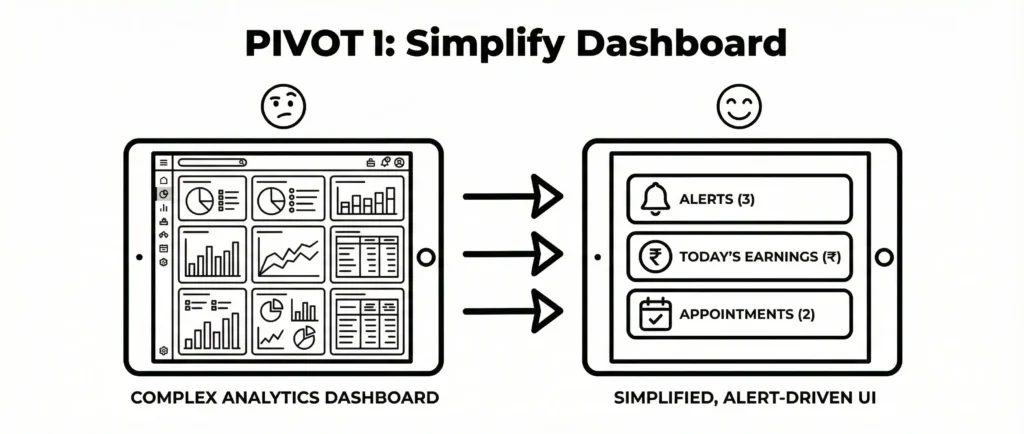
Key Pivot 1: Dashboard Simplification
- Initial Assumption: Owners wanted a data-rich, comprehensive analytics dashboard.
- Reality Check: During contextual testing, the dense UI overwhelmed users.
- The Pivot: Stripped the dashboard back to a ‘One-Screen Glanceable’. Focused entirely on actionable alerts (Low Stock, Today’s Earnings, Pending Appointments).
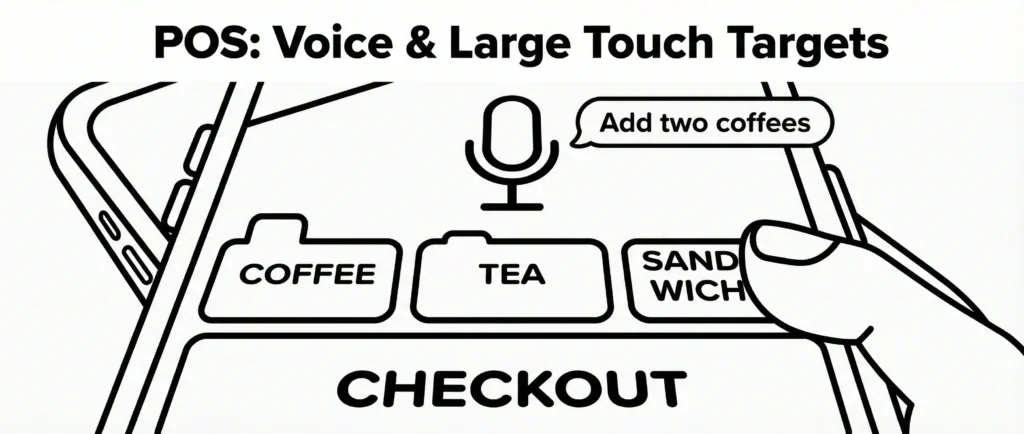
Key Pivot 2: Modality and Accessibility
- Initial Assumption: Standard form fields for data entry.
- Reality Check: Staff struggled with precise tapping during the ‘afternoon rush’.
- The Pivot: Introduced voice-input functionality for searching items/services and significantly increased button sizes for one-handed, rapid use.
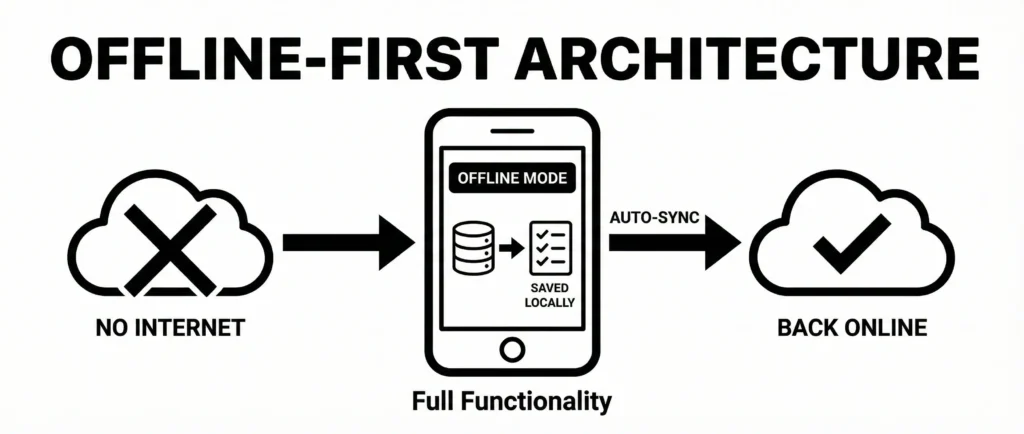
Key Pivot 3: The Connectivity Reality
- Initial Assumption: Standard cloud-syncing.
- Reality Check: Intermittent 4G/5G inside concrete store structures caused sync failures and user panic.
- The Pivot: Transitioned to a hard offline-first model. Designed a prominent, reassuring ‘Offline Mode’ indicator with seamless background syncing once a connection is re-established.
6. Design Leadership & Impact Validation
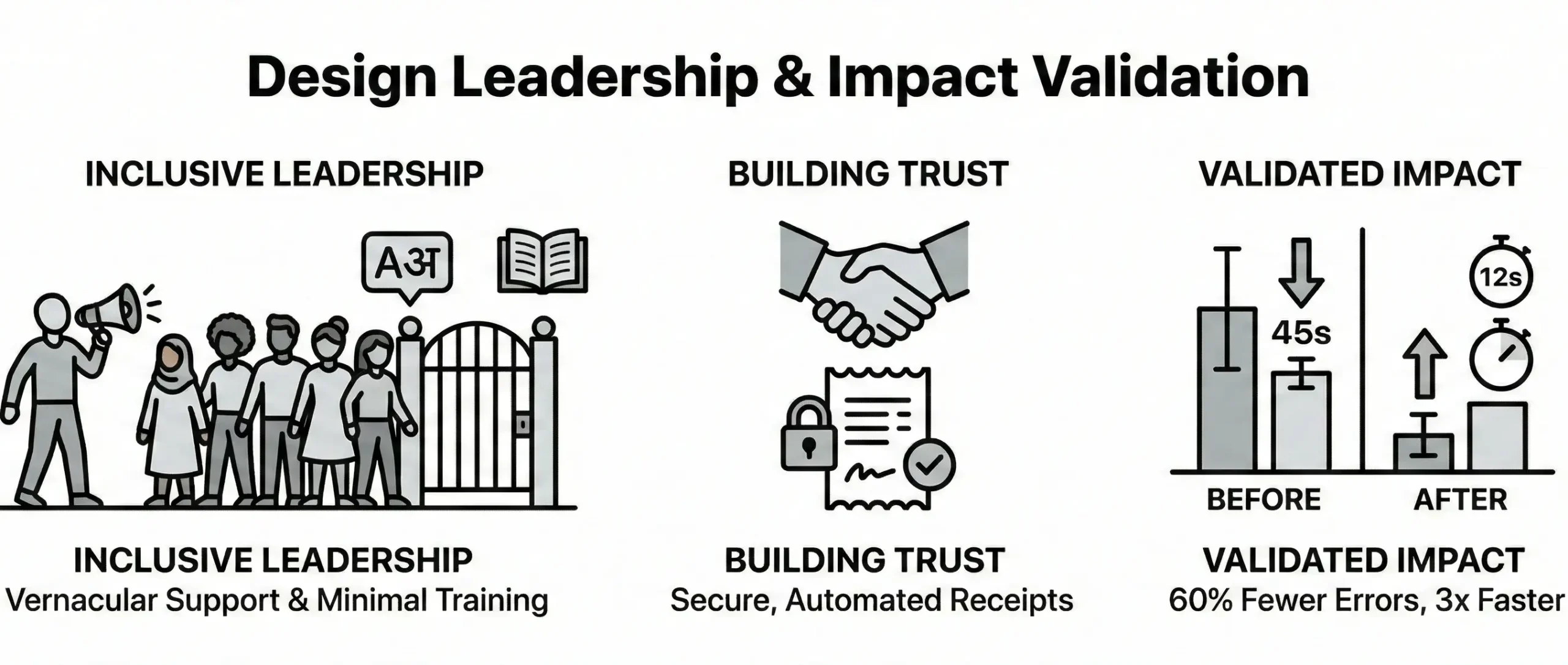
As the project lead, driving this POC meant balancing business realities with user needs.
- Advocating for Inclusive Design: Championed vernacular language support and heavily reduced the training curve to ensure the product could be handed to a new hire with zero onboarding time.
- Security & Trust: Integrated secure, automated UPI receipt generation, building trust for both the merchant and the consumer.
- Metrics & De-risking: Through timed task tests at mock counters, the redesigned flow (post-pivot) demonstrated a 60% drop in data entry errors and reduced average transaction logging time from 45 seconds to 12 seconds.
7. The Roadmap Forward
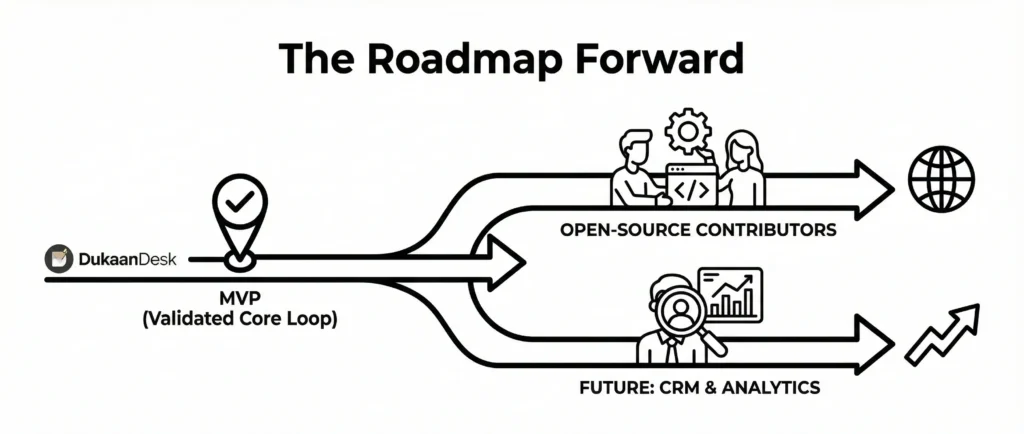
DukaanDesk’s MVP successfully validates the transactional core loop. By proving that micro-SMBs will adopt digital tools if they respect their operational realities, the foundation is set.
Next Steps:
- Handing off the validated design system to open-source engineering contributors.
- Future roadmap includes basic CRM functionalities (identifying repeat customers) and predictive analytics for seasonal inventory ordering.