
The Domain Decryption Framework
Extracting B2B Knowledge Rapidly
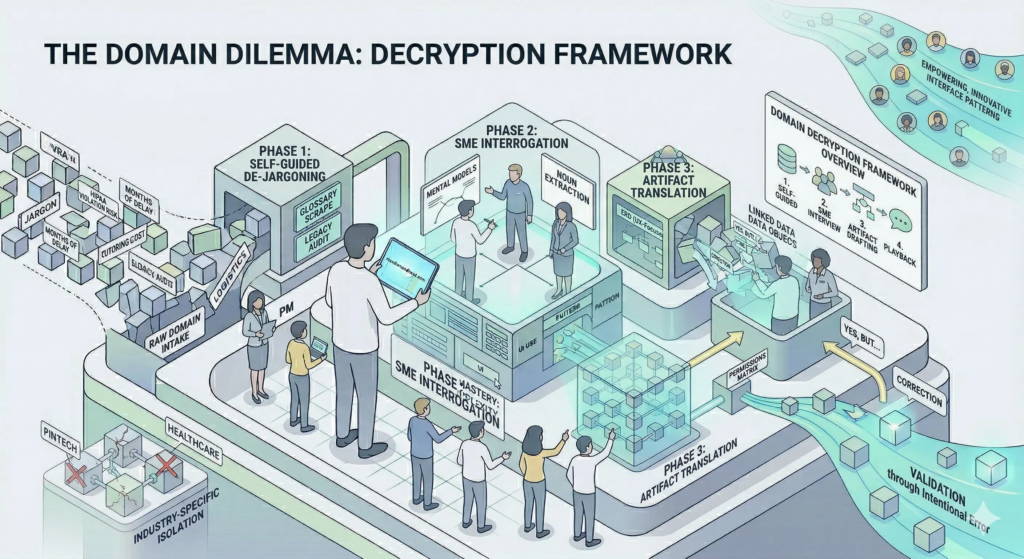
Stepping into a highly complex, unfamiliar B2B SaaS domain can feel like trying to read the matrix. When you are tasked with designing systems that require deep cognitive harmony for the user, you cannot afford to wait months to passively absorb industry knowledge. You need a systematic extraction process.
The goal here isn’t to become an encyclopedic expert; it is to learn just enough of the right things to map the system, understand the user’s mental models, and start designing.
Here is a structured, four-phase framework for rapidly extracting and operationalizing domain knowledge from Subject Matter Experts (SMEs) and stakeholders.
Phase 1: The Pre-Flight (Self-Guided De-Jargoning)
Never walk into an SME interview asking them to explain the absolute basics. Their time is expensive, and you need to reserve it for nuanced, high-value questions.
- Scrape the Glossary
Spend your first 48 hours aggressively compiling a glossary of acronyms and industry terms.
Understand what the words mean in a literal sense before you try to understand how they connect. - Audit the Legacy System (or Competitors)
Walk through the existing workflows.
Take screenshots.
Map the current happy paths even if you don’t fully understand the why behind them yet. - Identify the Core Entities
What are the main nouns of this system?
(e.g., In a compliance tool, the nouns might be Policies, Audits, Vendors, and Incidents).
Phase 2: Structured Extraction (The SME Interrogation)
When you finally sit down with Product Managers, lead engineers, or industry experts, control the conversation.
SMEs often suffer from the curse of knowledge and will dive into edge-case rabbit holes.
Your job is to keep them at the systemic level.
- Ask for the ‘Day in the Life’
Don’t ask about features.
Ask about triggers.
‘When a user logs in on a Tuesday morning, what is the very first thing they are panicked about?‘ - Map the Relationships
Use your list of nouns from Phase 1.
Ask the SME how they connect.
“Can a single Vendor have multiple Audits? Can an Incident exist without a Policy attached to it?“ - Uncover the True Mental Model
Often, the legacy software dictates a workflow that the user actually hates.
Ask the SME: “If we were doing this on a giant whiteboard instead of a screen, how would the user group this information?”
This is how you shift a product’s paradigm, for example, transforming a compliance tool’s vibe from a tool of policing to a collaborative partner.
Phase 3: Artifact Translation (Visualizing the Complexity)
SMEs speak in paragraphs and bullet points. Designers speak in nodes and edges. You must translate their brain-dump into structural artifacts immediately to see where the gaps are.
- Build an Entity-Relationship Diagram (ERD)
You don’t need to be a database architect, but you need a UX-focused ERD.
Draw out the core objects, their attributes, and how they nest within one another. - Create a System Map, Not Just a User Journey
In B2B SaaS, one user’s action often triggers a state change for another user.
Map the ecosystem.
If User A approves a document, what happens to User B’s dashboard? - Draft a Permissions Matrix
B2B complexity often lives in Role-Based Access Control (RBAC).
Document who can View, Edit, Create, or Delete every major object in the system early on.
Phase 4: The Playback (Validation Through Intentional Error)
The fastest way to get the right answer from an expert is to confidently present them with a slightly wrong answer.
- Pitch the System Back
Present your ERDs, system maps, and low-fidelity wireframes to the SMEs. Walk them through the logic you extracted. - Listen for the “Yes, but…”
You want them to correct you here. It is much cheaper to have an SME tear apart a diagram made of sticky notes than a high-fidelity prototype. When they correct your map, they are handing you the nuanced domain expertise you were missing. - Iterate and Isolate
Once the foundational system architecture is validated, you can isolate specific, complex workflows and begin designing the interface with confidence, knowing the underlying structure is sound.