
Turn Conversations into Clarity
Domain Decryption Template
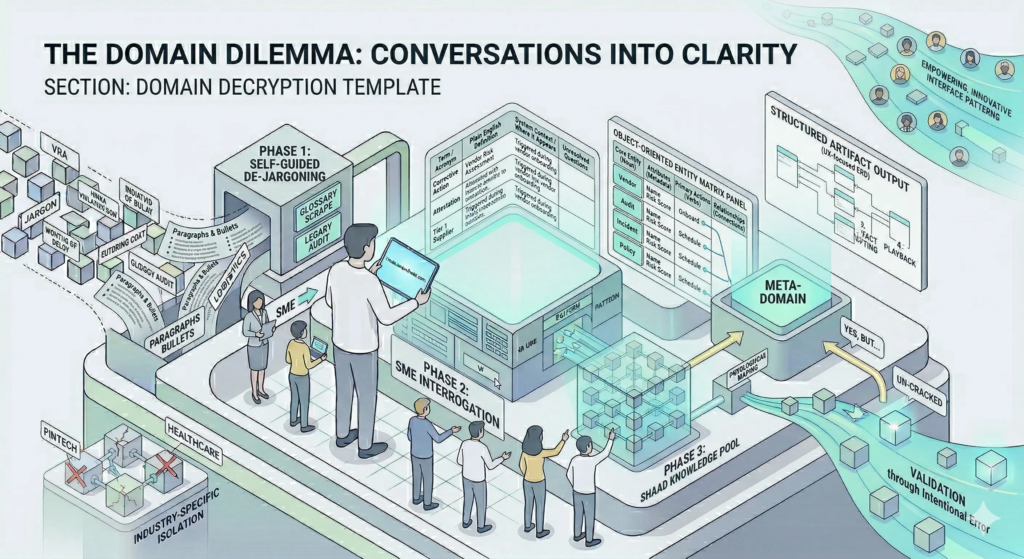
A spreadsheet template based on this framework that you could use to structure your SME interviews and entity mapping for your next project.
Here is a structured spreadsheet template designed to operationalize the Domain Decryption Framework. You can easily copy and paste these tables directly into Excel, Google Sheets, or Notion.
To make the template actionable, it is pre-filled with placeholder data for a hypothetical B2B SaaS compliance platform (e.g., a tool shifting the paradigm of supply chain compliance from policing to partner).
Sheet 1: The Glossary & Jargon Tracker (Pre-Flight)
Use this sheet to aggregate domain-specific terminology before and during your SME interviews.
| Term / Acronym | Plain English Definition | System Context / Where it Appears | Unresolved Questions |
| VRA | Vendor Risk Assessment | Triggered during vendor onboarding | Is this a manual upload or API pull? |
| Corrective Action | A mandatory fix required after a failed audit | Linked directly to an ‘Incident’ object | Who has the authority to close this out? |
| Attestation | A formal declaration that a policy is met | Dashboard, Policy Review Module | Does this require a digital signature? |
| Tier 1 Supplier | Direct supplier to the primary enterprise | Vendor mapping, filtering | Do we need to map Tier 2 and Tier 3 yet? |
Sheet 2: SME Interview & Mental Model Extraction
This sheet structures your conversations with stakeholders, focusing on systemic triggers and mental models rather than just feature requests.
| SME Name & Role | Core Workflows Discussed | Primary Triggers (What starts the task?) | Current Legacy Pain Points | The ‘Whiteboard’ Mental Model |
| Sarah (Head of Audits) | Initiating a quarterly vendor audit | Automated 90-day system flag | Too many false positives; feels like policing vendors unnecessarily. | Wants a collaborative ‘partner’ view where vendors self-report issues first. |
| David (Lead Engineer) | Managing API integrations for Tier 1s | New vendor profile creation | Legacy system requires manual database mapping for each new vendor. | Sees it as a simple ‘plug-and-play’ hub-and-spoke model. |
| Elena (Compliance Officer) | Reviewing flagged incidents | Email notification of a failed VRA | Context switching; has to open 4 different tabs to see the vendor’s history. | Needs a single ‘incident dossier’ that rolls up all historical data. |
Sheet 3: Object-Oriented Entity Matrix (Artifact Translation)
Translate the nouns you hear in SME interviews into a structured relational map before drawing a single screen.
| Core Entity (Noun) | Key Attributes (Metadata) | Primary Actions (Verbs) | Relationships (Connections) |
| Vendor | Name, Risk Score, Status, Region | Onboard, Archive, Message, Flag | Has many Audits; Has many Incidents |
| Audit | Date, Score, Auditor Name, Type | Schedule, Submit, Export, Re-open | Belongs to one Vendor; Triggers Incidents |
| Incident | Severity, Date Logged, Description | Resolve, Escalate, Assign | Belongs to one Vendor; Belongs to one Audit |
| Policy | Title, Version, Effective Date | Draft, Publish, Deprecate | Governs many Audits |
Sheet 4: RBAC Permissions Matrix
Map out the systemic butterfly effects of user roles early to avoid complex re-designs later.
| Core Entity | System Admin (Global) | Auditor (Internal) | Vendor (External Partner) | Viewer (Read-Only) |
| Vendor Profiles | Full CRUD (Create, Read, Update, Delete) | Read, Update (Status only) | Read, Update (Own details only) | Read |
| Audits | Full CRUD | Create, Read, Update | Read (Own audits only) | Read |
| Incidents | Full CRUD | Create, Read, Update | Read, Update (Add comments) | Read |
| Policies | Full CRUD | Read | Read | Read |