
Whiteboard Mental Model Interview Script
Stop Talking Screens, Start Mapping Thinking
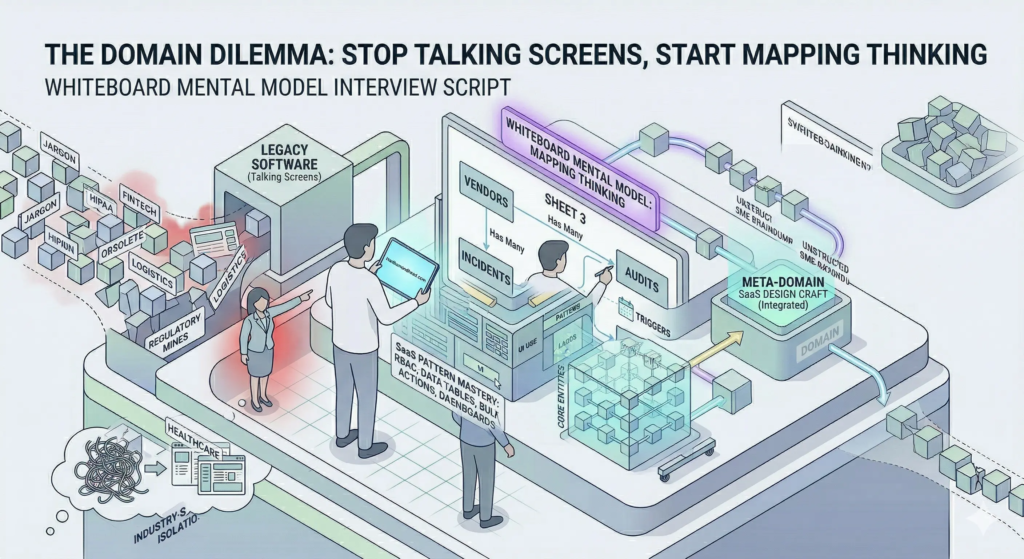
A script containing the precise questions you can use to guide an SME through the Whiteboard Mental Model exercise mentioned in Sheet 2.
When interviewing Subject Matter Experts (SMEs), their natural instinct is to describe the current software interface rather than their actual workflow. They will say things like, “First, I click the blue dropdown, then I export the CSV.”
Your goal as a designer is to strip away the UI and get to the underlying logic.
This script is designed to politely interrupt that curse of knowledge and force the SME to think in abstract, relational terms.
The Setup: Breaking the Legacy Anchor
Start by explicitly removing the current software from the conversation. You want to establish that this is a conceptual exercise, not a feature request gathering session.
“For the next 30 minutes, I want us to pretend computers haven’t been invented yet. If you had to manage this entire process using an empty room, a giant whiteboard, and unlimited sticky notes, how would you do it?”
“Try to completely forget what the current dashboard looks like. I don’t want to know how the software forces you to work today. I want to know how your brain wants to work.”
Phase 1: Core Entity Extraction (Finding the Nouns)
Once they are in the whiteboard mindset, guide them to identify the primary objects they care about.
“When you walk into the office on your busiest day, what is the absolute most important piece of information you need to see first?”
“If you were grouping your sticky notes into buckets, what are the three or four main categories?” (Listen for nouns: e.g., Vendors, Incidents, Policies, Contracts).
“Of all these categories, which one acts as the ‘sun’ in your solar system? What does everything else revolve around?”
Phase 2: Relational Mapping (Drawing the Lines)
Now, figure out how those core entities interact. This forms the basis of your system architecture and database structure.
“Let’s say you have a sticky note for a ‘Vendor’ and a sticky note for an ‘Audit’. Can a single vendor have multiple audits stuck to them, or just one?”
“If you tear up the sticky note for an ‘Audit’ and throw it away, what happens to the ‘Incident’ sticky notes attached to it? Do they disappear, or do they float back to the main Vendor file?”
“When a new object enters the system, like a brand new contract, who is the very first person that needs to hold that sticky note?”
Phase 3: Uncovering the Triggers (The ‘Why’ and ‘When’)
Software shouldn’t just store data; it should facilitate action. You need to know what prompts the user to move between these entities.
“What is the exact trigger that makes you walk over to the whiteboard and update a Vendor’s status? Is it an email, a phone call, or a date on the calendar?”
“When you look at this whiteboard, what tells you that something is wrong? What makes you panic?”
“If you are out sick for a week, what is the most critical process that breaks down because you aren’t here to move the sticky notes?”
Phase 4: The Paradigm Shift (The Magic Wand)
This is where you extract the strategic vision and shift the tone of the software (for example, shifting a system from feeling like a policing tool to a collaborative partner).
“If I could wave a magic wand and automate exactly one painful task on this whiteboard, which one would save you the most mental energy?”
“Currently, this process feels very reactive. What information would you need to see on this board to make it proactive?”
“How do we want the user on the other end of this system to feel when they interact with us? Right now, do they feel like they are being audited, or do they feel like they are being guided?”
Handling the UI Relapse
Inevitably, an SME will slip back into describing the current interface. When they say, “Well, I just go to the ‘Reports’ tab and click generate…” politely interrupt them:
“I’m going to pause you right there. Remember, we don’t have tabs or buttons in our whiteboard room yet. What is the actual question you are trying to answer when you go looking for that report?”