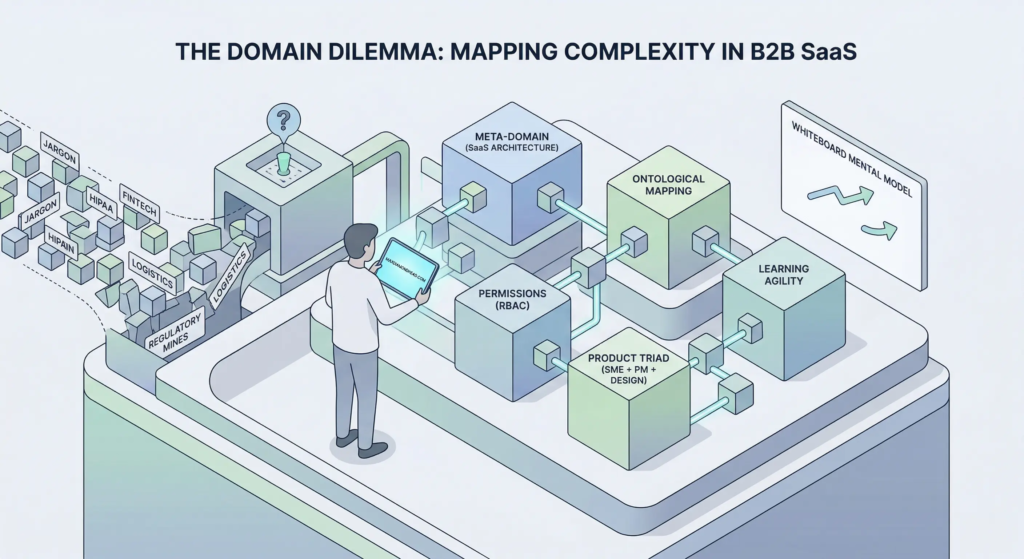
A Critical Look at Expertise in B2B SaaS Design
The debate over whether a B2B SaaS Product Designer needs deep domain expertise – such as years spent in healthcare, fintech, or logistics – is often framed as a binary.
One camp insists that B2B software is too complex for an outsider to grasp without years of industry immersion. The other champions the generalist UX approach, arguing that a good designer can design for anything.
A critical exploration of this topic reveals that both absolute stances are flawed.
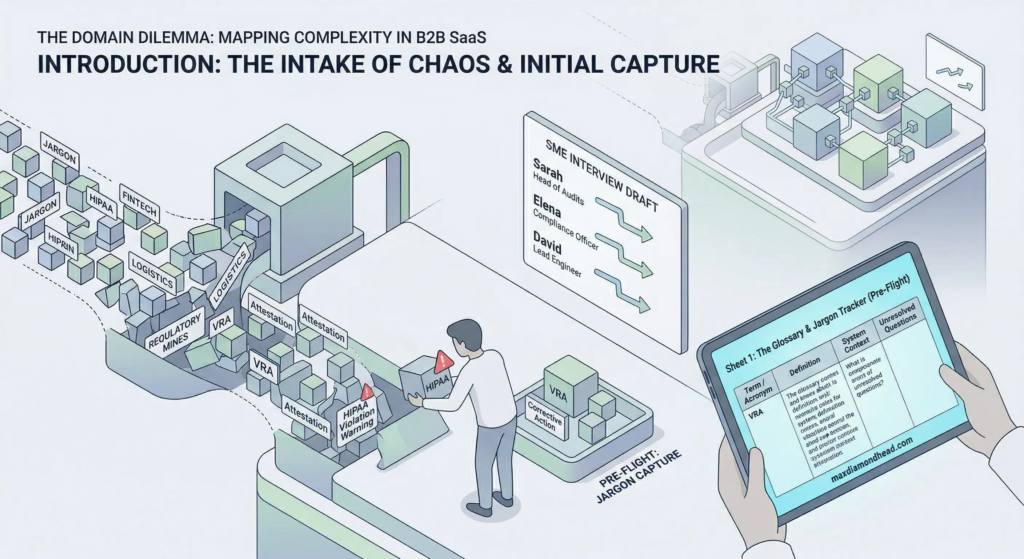
The reality of modern B2B SaaS is that it is simultaneously too complex for a complete novice to navigate blindly, and too dynamic for a static industry expert to dominate.
Here is a critical examination of the tension between domain expertise, the shifting sands of SaaS, and what it truly takes to design enterprise software.
The Valid Fear: Why the Domain Expert Requirement Exists
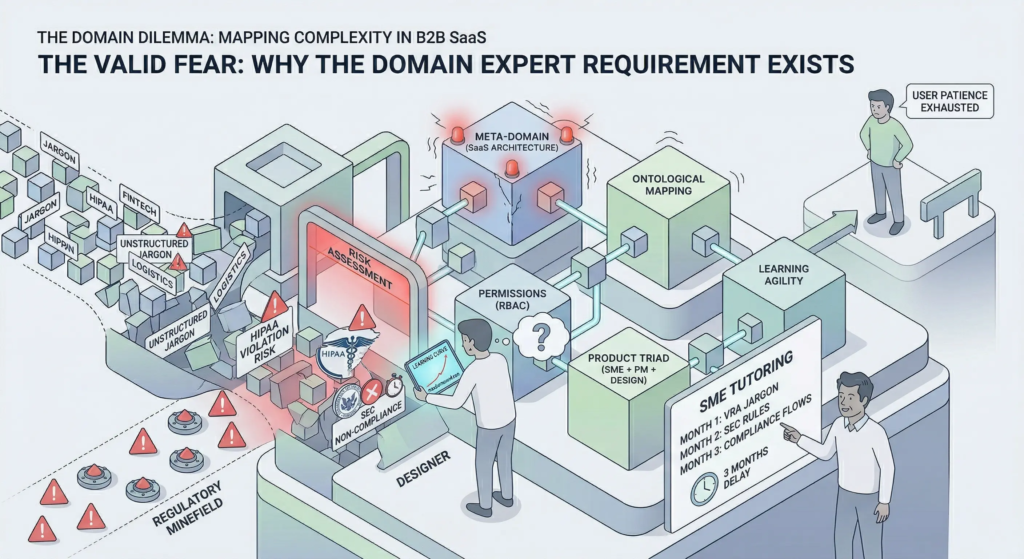
To critically assess the myth, we first have to validate why companies cling to it. Hiring managers don’t ask for domain expertise out of malice; they do it out of risk mitigation.
In high-stakes B2B environments, ignorance isn’t just an inconvenience; it can be catastrophic.
- Regulatory Minefields
In fintech or healthtech, a poorly designed permission toggle isn’t just bad UX; it’s a HIPAA or SEC violation. - The Cost of Context
When a designer doesn’t understand the basic vernacular of supply chain logistics, Product Managers and Engineers have to spend months acting as tutors before a single wireframe is drawn. - User Patience
Enterprise users are busy professionals. They have little patience for software that feels like it was designed by someone who doesn’t understand their daily grind.
Companies hire for domain expertise because they want to bypass the steep learning curve. They want a designer who hits the ground running.
The Fatal Flaw: When Expertise Becomes a Liability
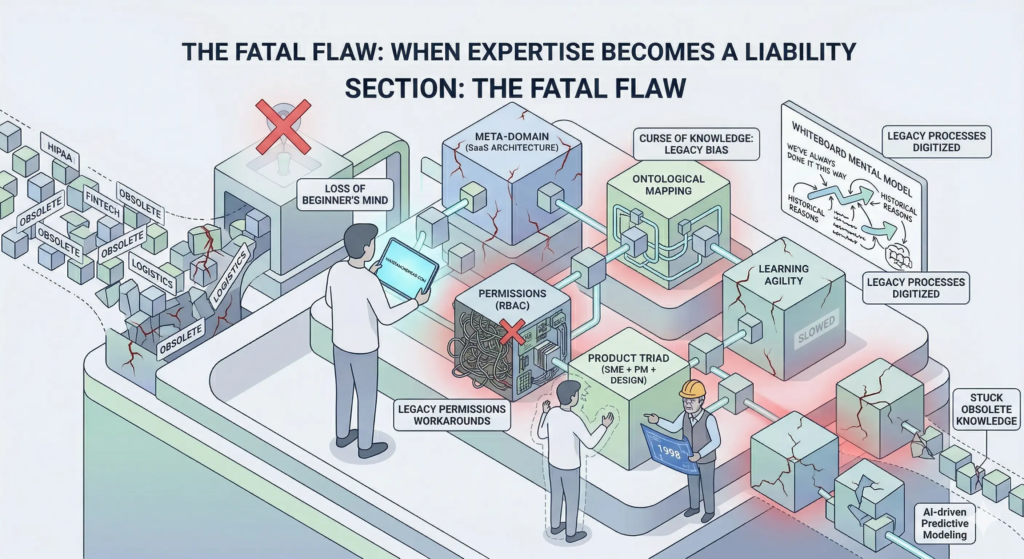
However, the assumption that historical industry knowledge guarantees better software design breaks down when confronted with the reality of the SaaS business model.
1. The Target is Always Moving
SaaS is inherently disruptive. If you hire a legacy logistics expert, their expertise might be anchored in on-premise, manual-entry systems. When your product pivots to AI-driven, predictive supply chain modeling, their historical knowledge becomes obsolete, or worse, a tether holding the product back.
2. The Curse of Knowledge and Legacy Bias
True domain experts often suffer from the curse of knowledge. Because they understand the complex workarounds of their industry intimately, they fail to recognize them as friction points. Instead of innovating, they often digitize existing, broken processes. They design interfaces that reflect the complexity of the backend, rather than abstracting it for the user.
3. The Loss of the Beginner’s Mind
The most valuable question a designer can ask is, ‘Why do we do it this way?‘ A domain expert rarely asks this, because they already know the historical reason. A fresh designer, acting as a proxy for a new user, will challenge assumptions that insiders take for granted.
The Synthesis: Distributed Cognition and the Meta-Domain
If a complete novice is dangerous, but a rigid expert is a liability, what is the solution? A critical approach requires shifting the burden of domain expertise from the individual to the system.
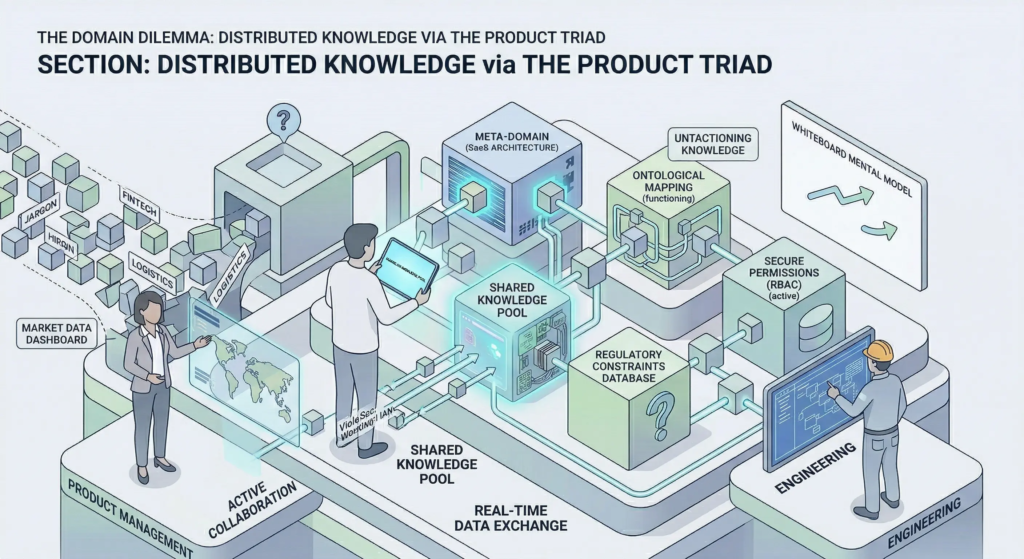
Distributed Knowledge via the Product Triad
A successful B2B SaaS team doesn’t require a designer to be an encyclopedia; it requires a functional Product Triad (Product Management, Engineering, and Design).
In this model, domain expertise is a shared responsibility. The Product Manager and Subject Matter Experts (SMEs) hold the deep industry context and regulatory constraints.
The designer’s responsibility is not to possess that knowledge, but to extract, structure, and translate it.
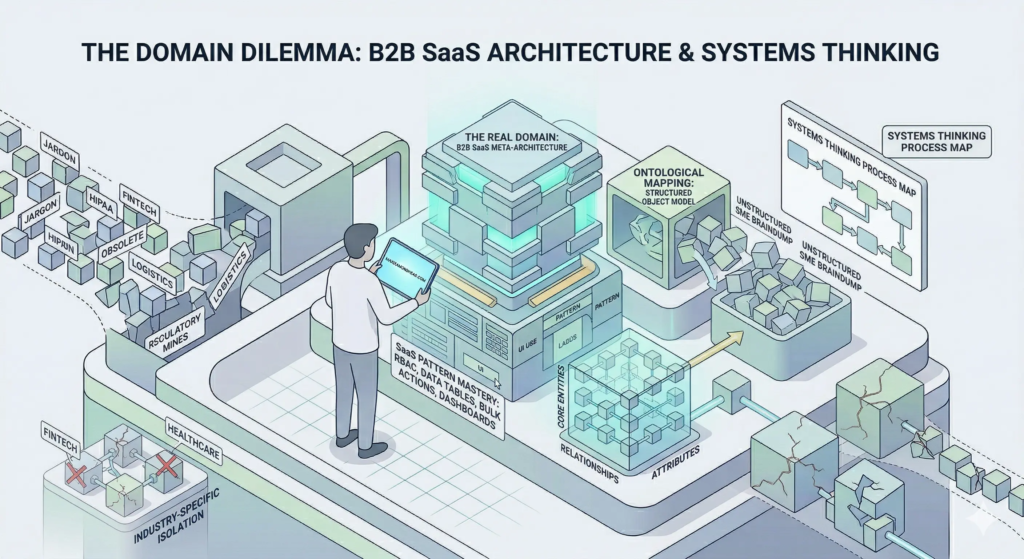
The Real Domain: SaaS Architecture and Systems Thinking
We must redefine what expertise means for the designer.
Their domain is not healthcare or finance; their domain is B2B SaaS itself.
A highly effective SaaS designer possesses:
- SaaS Pattern Mastery
Deep understanding of complex data tables, role-based access control (RBAC), bulk actions, API configurations, and high-density dashboards. - Ontological Mapping
The ability to take a massive, unstructured brain-dump from an SME and organize it into a logical, relational object model that makes sense to a user. - Extreme Learning Agility
The methodological skill to learn just enough about a new domain to ask the right questions, without getting bogged down in irrelevant details.
The Verdict
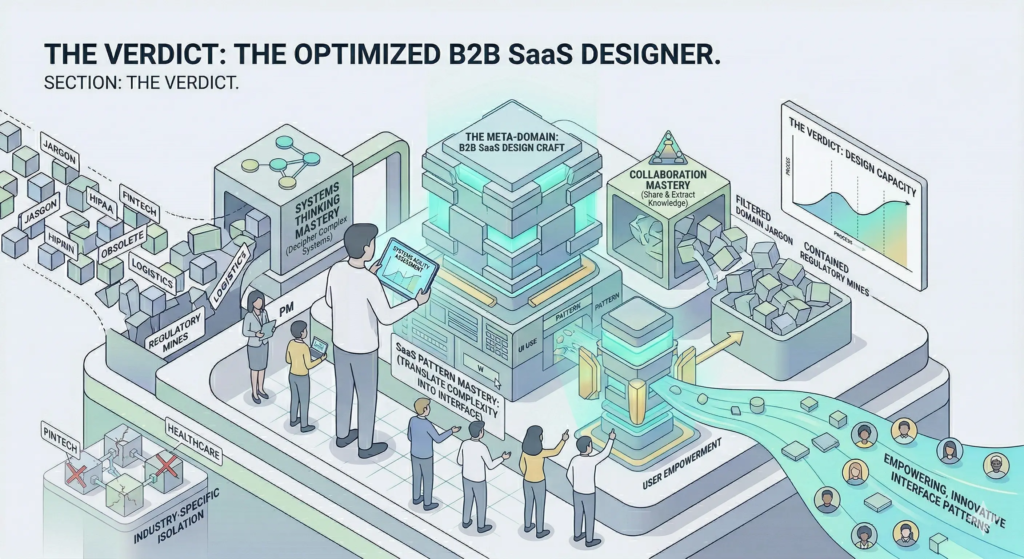
The prevailing notion that a B2B SaaS designer must be a domain expert is a symptom of a misaligned hiring process. It conflates the subject matter of the software with the craft of software design.
While a baseline understanding of an industry is helpful to reduce onboarding friction, the ultimate indicator of success in a shifting B2B landscape is not what a designer already knows.
It is their capacity to decipher complex systems, collaborate with those who do hold the knowledge, and translate that complexity into an interface that empowers the user.
Additional Resources
The Domain Decryption Framework: Extracting the B2B Knowledge Rapidly
Turn Conversations into Clarity: Domain Decryption Template
Whiteboard Mental Model Interview Script (or Stop Talking Screens, Start Mapping Thinking)